Up to20%OFF
Bulk Orders 20+ bottles
Volume pricing applies automatically from three bottles and reaches 20% at twenty. Larger runs, institutional supply and custom timelines get a quote.
Ask about bulk
Neurocognitive Research
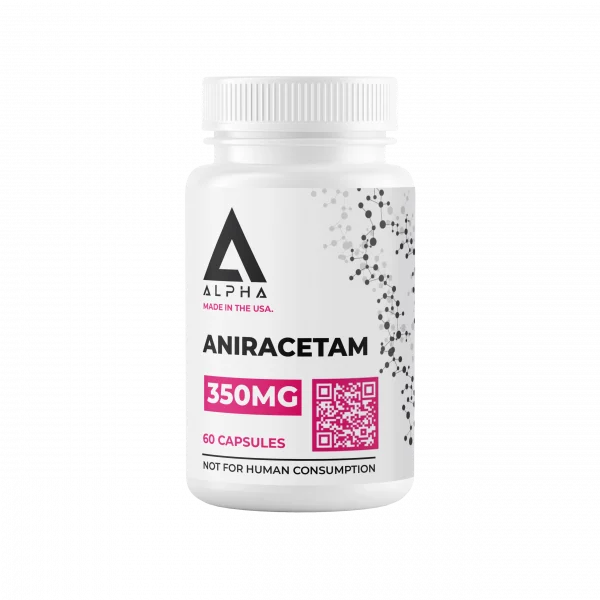
Aniracetam is a synthetic racetam used in lab research on memory, learning and glutamate receptors. We sell it as capsules for laboratory research use only. This page covers its identity data and what published studies examined.
Bundle & save
Referral program · researchers save 10%, you earn 15% backThe compounds researchers order most, by verified order volume.
More ways to save
Volume pricing applies automatically from three bottles and reaches 20% at twenty. Larger runs, institutional supply and custom timelines get a quote.
Ask about bulkShipping batch 5513X
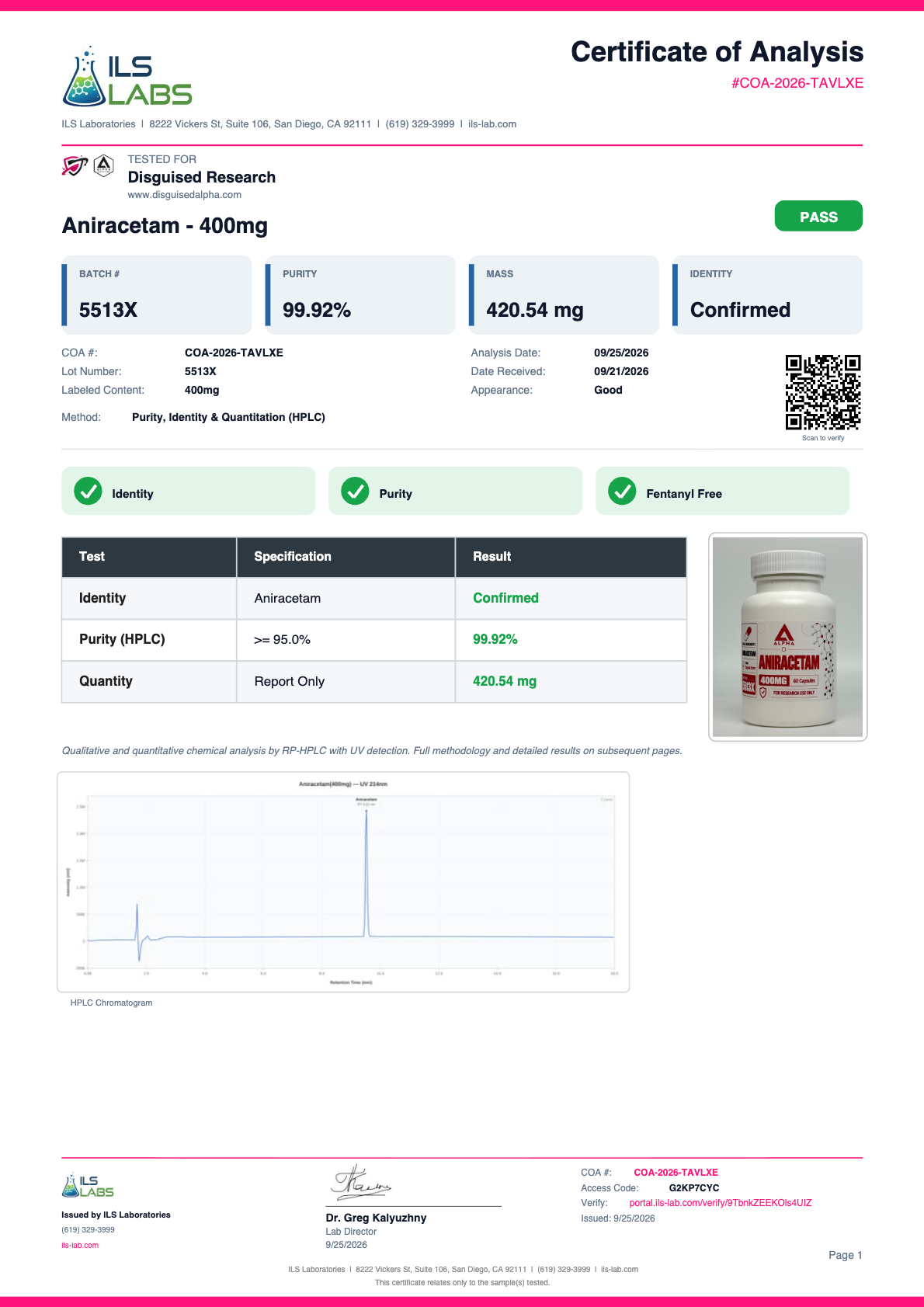
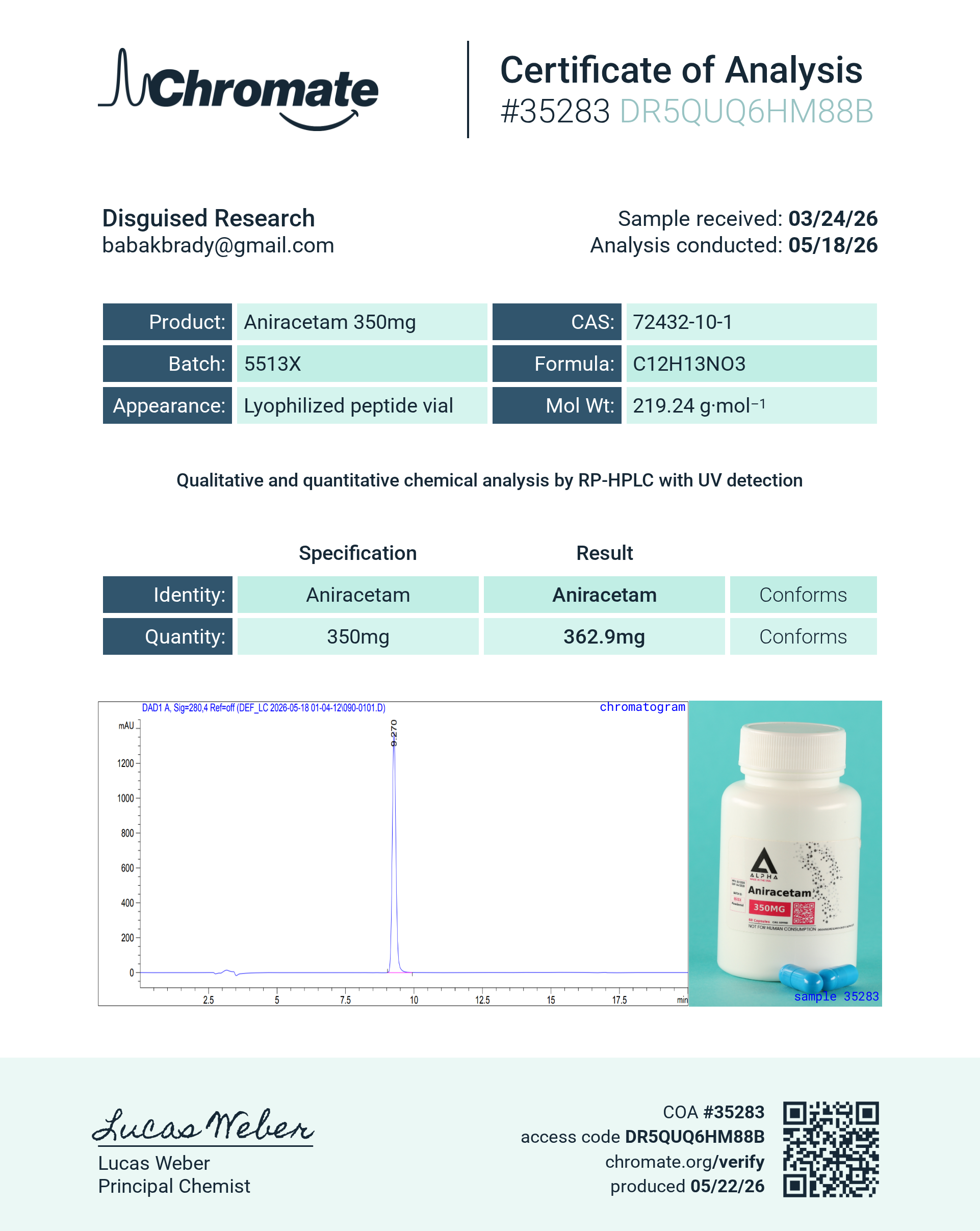
Open the certificate matched to this shipping batch.
Verified test results
Each batch is analyzed by an independent third-party laboratory before release. The lots below were tested by Chromate and ILS Laboratories. Below is the report for lot 5513X, summarized from the certificate the lab published.
Every lot we have published for this compound, grouped by the lab that tested it, newest first. Open any certificate below, exactly as the lab released it.
Side by side
Peer-reviewed literature
Every reference below is a published, peer-reviewed record, linked to its PubMed entry. Provided for educational reference only - not product claims.
Important research notice
Not for human, veterinary, or food use. This product is sold exclusively for laboratory research purposes. It is not intended to diagnose, treat, cure, or prevent any disease, and has not been evaluated by the FDA.
All referenced publications and registries are sourced from peer-reviewed journals and official registries. They are provided for educational reference only and are not product claims.
By purchasing, you confirm you are a qualified researcher and will handle this product in accordance with all applicable laws and regulations.
Ready when you are
The lot on this page links to the signed certificate for that batch.
Encapsulated research material
Aniracetam is a synthetic racetam used in lab research on memory, learning and glutamate receptors. We sell it as capsules for laboratory research use only. This page covers its identity data and what published studies examined. It also shows how to store it and how to match your lot to its certificate.
Aniracetam is 1-(4-methoxybenzoyl)-2-pyrrolidinone. Its research code is Ro 13-5057. A 2010 review places it with the piracetam-like racetams (Malykh and Sadaie, 2010).
Like piracetam, it is built on a 2-pyrrolidinone ring, a five-membered lactam. A 4-methoxybenzoyl (anisoyl) group sits on the ring's nitrogen. The molecule has no stereocenters.
| Formula | C₁₂H₁₃NO₃ |
|---|---|
| Molecular weight | 219.24 g/mol |
| Monoisotopic mass | 219.09 (PubChem CID 2196) |
| Other names | Ro 13-5057, 1-p-anisoyl-2-pyrrolidinone |
| Class | racetam; positive allosteric modulator of AMPA receptors |
| Format | capsules in a sealed container |
Labs study the compound in models of memory, learning and behavioral flexibility. Work also covers emotion-linked behavior, stress response, perception and sensory integration. At the cell level, research looks at AMPA receptor activity, excitatory neurotransmission and synaptic signaling.
It is a widely known racetam in nootropic and neurobehavioral research. Labs still use it to study how cognition and emotion-linked behavior connect.
Mechanism and behavior data on aniracetam come from cells, brain tissue and rodents. Each line below names the model.
| AMPA receptors | In frog (Xenopus) oocytes that expressed rat brain mRNA, it potentiated AMPA-type receptor responses. It did not change kainate, NMDA or GABA responses (Ito et al., 1990). |
|---|---|
| Channel closing | Recordings in hippocampal slices showed that it reduced desensitization. That is the closing of the channel while glutamate is still bound (Isaacson and Nicoll, 1991). |
| Binding site | Crystal structures place it where two receptor subunits meet. The authors proposed that it slows channel closing after glutamate leaves (Jin et al., 2005). |
| Metabolism in rats | Most of the compound became N-anisoyl-GABA, p-anisic acid and 2-pyrrolidinone (Ogiso et al., 1998). Of these, 2-pyrrolidinone had the highest brain-to-plasma ratio measured (Ogiso et al., 2000). |
| Acetylcholine in rats | In stroke-prone hypertensive rats, the metabolites N-anisoyl-GABA and p-anisic acid raised acetylcholine release in brain regions. Aniracetam itself did not (Nakamura and Shirane, 1999). |
| Learning models | A 1982 study examined rats and mice with learning and memory deficits induced in the lab. It compared aniracetam with piracetam (Cumin et al., 1982). |
| Healthy mice | A 2014 study tested healthy adult C57BL/6J mice. They did not differ from controls in water maze, fear conditioning or rotarod tests (Elston et al., 2014). |
Full citations and more detail are in the aniracetam research guide.
Every order ships with certificate access for its lot. To check yours:
Retain the product label and lot number with the research record. Review the matching certificate of analysis for test coverage and reported results. Identity, analytical purity, measured content, sterility and endotoxin testing are distinct assessments; one does not establish the others.
Follow the supplied label and your laboratory’s validated handling and storage procedures. Record the vehicle, concentration and preparation date where relevant. Dry-material stability does not establish the shelf life of a prepared solution.
It is the stated quantity per unit, separate from the number of units in the bottle. A purity percentage is not a measurement of milligrams per capsule or tablet. Use the matching lot report for the measurements actually performed.
Open the linked certificate for the assigned lot or use the COA portal. Check sample identity, methods, date and reported measurements. A report for another lot or formulation is not a substitute.
As a positive allosteric modulator. In Xenopus oocytes expressing rat brain mRNA it reversibly potentiated quisqualate-type (AMPA) receptor responses without affecting kainate, NMDA or GABA responses, and in patches from hippocampal slices it strongly reduced glutamate receptor desensitization. Crystal structures of the GluR2 ligand-binding domain place it at the dimer interface, beside the hinge of the glutamate-binding clamshell.
Yes: a 2010 review places it in the first subgroup of piracetam-like drugs, with piracetam, oxiracetam, pramiracetam and phenylpiracetam. Like piracetam it is built on a 2-pyrrolidinone ring, here with a 4-methoxybenzoyl (anisoyl) group on the ring nitrogen: 1-(4-methoxybenzoyl)-2-pyrrolidinone, C₁₂H₁₃NO₃ at 219.24 g/mol as this page lists. Its research code was Ro 13-5057.
No. Drugs@FDA lists no product containing aniracetam (openFDA search, 14 October 2026), and a 2021 study of supplements bought online names it among four drugs not approved for human use in the United States. The aniracetam on this page is sold for laboratory research only.
This page sells aniracetam as capsules, and each published lot's certificate of analysis is shown with the lab that tested it, ILS Laboratories or Chromate. It is sold exclusively for laboratory research purposes, not for human, veterinary, or food use, and ships from the US West Coast, by FedEx 2-Day shipping.
The current certificate is matched to the selected product option and assigned shipping batch.
Enable JavaScript to view the certificate for your selected option.
We share visit and purchase data with advertising partners to measure and show ads. Some US state laws, including California's, call that a sale or sharing of personal information. You can turn it off for this browser.
Ad sharing is on in this browser.
Saved in this browser only. For your account or other devices, email support@disguisedalpha.com. Privacy Policy