Up to20%OFF
Bulk Orders 20+ vials
Volume pricing applies automatically from three vials and reaches 20% at twenty. Larger runs, institutional supply and custom timelines get a quote.
Ask about bulk
Bioregulator
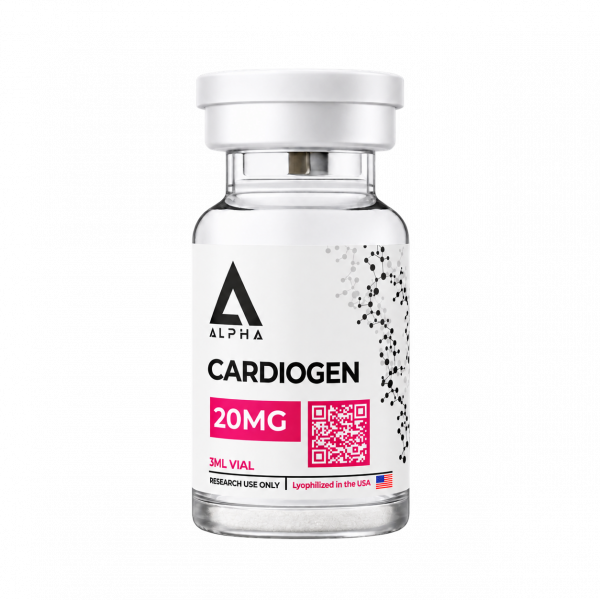
Cardiogen is a peptide research product in a 20MG lyophilized vial. It is sold for laboratory research use only.
Bundle & save
Referral program · researchers save 10%, you earn 15% backThe compounds researchers order most, by verified order volume.
More ways to save
Volume pricing applies automatically from three vials and reaches 20% at twenty. Larger runs, institutional supply and custom timelines get a quote.
Ask about bulkTechnical specifications
Important research notice
Not for human, veterinary, or food use. This product is sold exclusively for laboratory research purposes. It is not intended to diagnose, treat, cure, or prevent any disease, and has not been evaluated by the FDA.
All referenced publications and registries are sourced from peer-reviewed journals and official registries. They are provided for educational reference only and are not product claims.
By purchasing, you confirm you are a qualified researcher and will handle this product in accordance with all applicable laws and regulations.
Disguised Alpha · Lab records
Match the product and lot on your label to the original laboratory report.
Shipping batch CD01
No published certificate is currently matched to this shipping batch.
Lyophilized research material
Cardiogen is a peptide research product in a 20MG lyophilized vial. It is sold for laboratory research use only.
The Cardiogen peptide is the tetrapeptide Ala-Glu-Asp-Arg, or AEDR. It is one of a series of short peptides from a St Petersburg institute. Epitalon and pinealon are in the same series.
| Compound | Cardiogen (AEDR). |
|---|---|
| Strength | 20MG. |
| Format | lyophilized peptide research vial, lyophilized in the USA. |
| Formula | C₁₈H₃₁N₇O₉, 489.5 g/mol (PubChem). |
Labs use Cardiogen in cardiovascular pathway research. Other work looks at myocardial tissue-response models and vascular signaling. Cell signaling, stress-response pathways and cardiac biology are studied too. So are organ-specific peptide and tissue adaptation models. Research interest centers on how short regulatory peptides may act in cardiac signaling and tissue-response systems. The 20MG vial gives a clean, clearly labeled format for structured lab work.
The published work on this sequence is thin. About ten indexed papers exist. Most come from the peptide's home institute or its partner groups. Most used tissue explants, such as rat heart tissue, or cultured cells. The Cardiogen research guide lists the key studies.
Store the freeze-dried powder at -20°C, out of the light, until it is reconstituted. After that, keep it at 2 to 8°C, still away from light. Avoid freeze and thaw cycles.
Retain the product label and lot number with the research record. Review the matching certificate of analysis for test coverage and reported results. Identity, analytical purity, measured content, sterility and endotoxin testing are distinct assessments; one does not establish the others.
Follow the supplied label and your laboratory’s validated handling and storage procedures. Record the vehicle, concentration and preparation date where relevant. Dry-material stability does not establish the shelf life of a prepared solution.
The listed milligrams refer to material per vial, not concentration or administration instructions. A prepared solution has its own concentration and stability requirements. Verify the exact selected option and shipping lot.
Open the linked certificate for the assigned lot or use the COA portal. Check sample identity, methods, date and reported measurements. A report for another lot or formulation is not a substitute.
The tetrapeptide Ala-Glu-Asp-Arg (AEDR), one of the short peptides from the St Petersburg Institute of Bioregulation and Gerontology, whose 2021 review lists it beside epitalon (Ala-Glu-Asp-Gly) and pinealon (Glu-Asp-Arg). PubChem files it under its sequence (C₁₈H₃₁N₇O₉, 489.5 g/mol); a PubChem name search for cardiogen returns an unrelated compound, levocarnitine.
Mostly explants and cultured cells: heart explants from young and old rats, cultured mouse embryonic fibroblasts, late-passage human prostate fibroblast cultures, histone-binding assays and computer docking at amino acid and peptide transporters, plus one study in live rats. We found no study of it in people in PubMed under its name or sequence.
Not the peptide. The one Drugs@FDA product with the name, CARDIOGEN-82 (NDA 019414), is rubidium chloride Rb-82 from Bracco, unrelated to this tetrapeptide, and Drugs@FDA lists no product containing the cardiogen peptide (openFDA search, 14 October 2026). The cardiogen on this page is sold for laboratory research only.
This page sells Cardiogen as a peptide research product supplied in a 20MG lyophilized vial format, lyophilized in the USA. It is sold exclusively for laboratory research purposes, not for human, veterinary, or food use, and ships from the US West Coast, by FedEx 2-Day shipping, with tracked delivery on every order.
The current certificate is matched to the selected product option and assigned shipping batch.
Enable JavaScript to view the certificate for your selected option.
We share visit and purchase data with advertising partners to measure and show ads. Some US state laws, including California's, call that a sale or sharing of personal information. You can turn it off for this browser.
Ad sharing is on in this browser.
Saved in this browser only. For your account or other devices, email support@disguisedalpha.com. Privacy Policy