Up to20%OFF
Bulk Orders 20+ vials
Volume pricing applies automatically from three vials and reaches 20% at twenty. Larger runs, institutional supply and custom timelines get a quote.
Ask about bulk
Neurocognitive Research
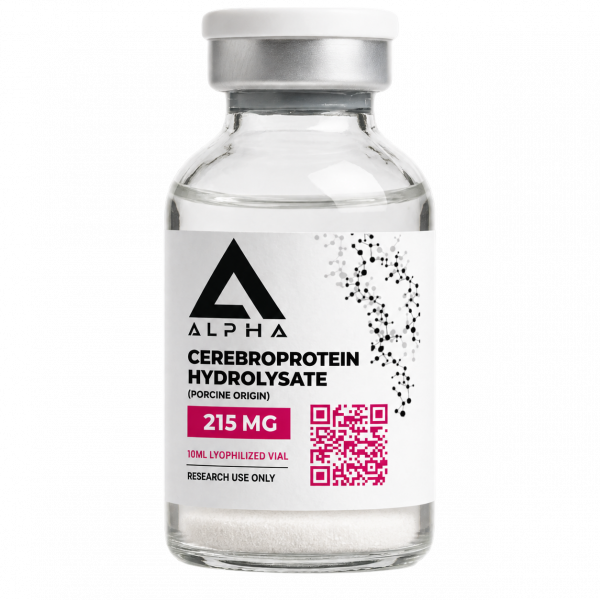
Cerebroprotein hydrolysate is a complex mix of peptides and amino acids for lab research. Each vial holds 215MG of lyophilized powder.
Bundle & save
Referral program · researchers save 10%, you earn 15% backThe compounds researchers order most, by verified order volume.
More ways to save
Volume pricing applies automatically from three vials and reaches 20% at twenty. Larger runs, institutional supply and custom timelines get a quote.
Ask about bulkShipping batch CB01
Open the certificate matched to this shipping batch.
Verified test results
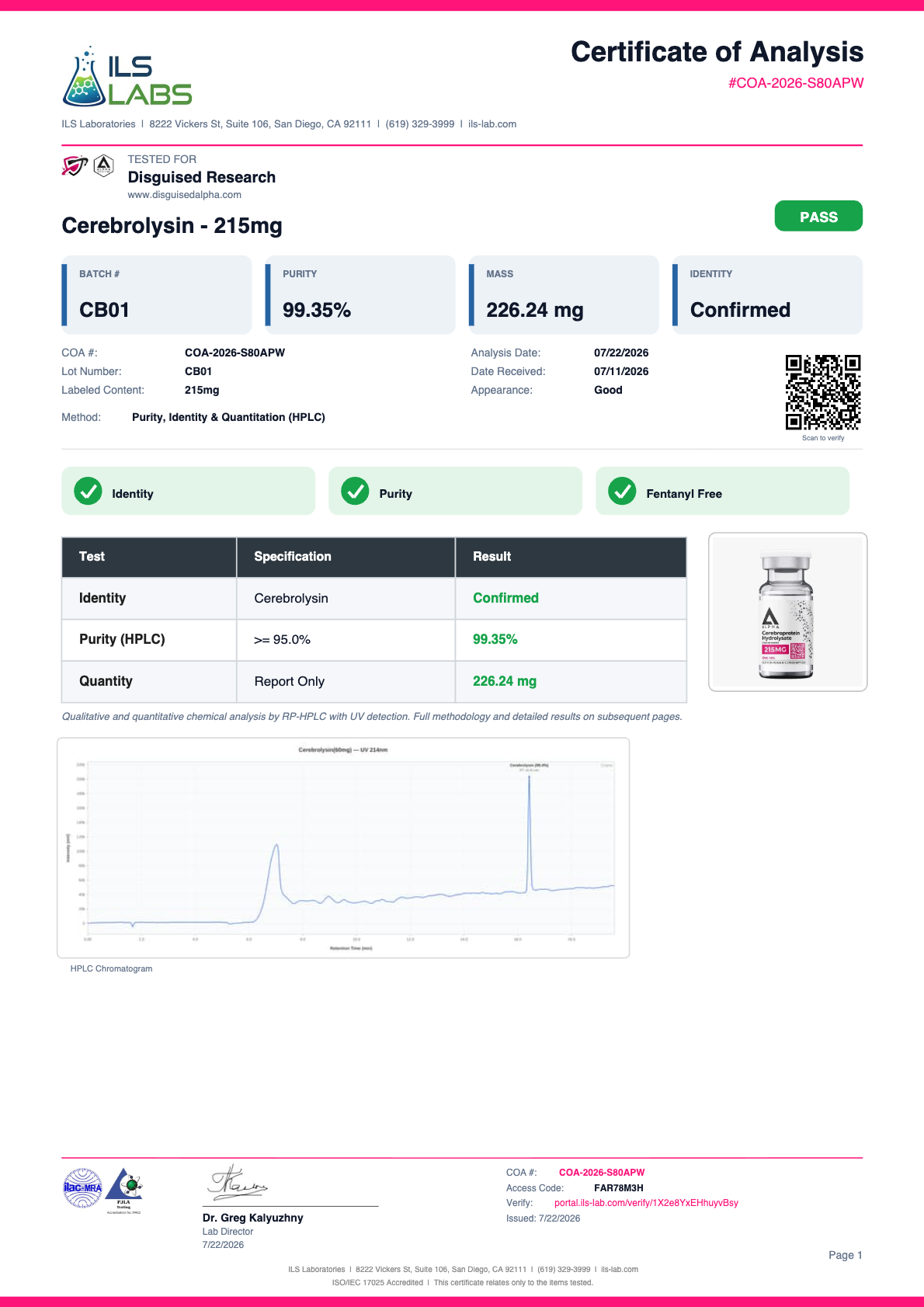
Each batch is analyzed by ILS Laboratories, an independent ISO/IEC 17025 accredited lab, before release. Below is the report for lot CB01, summarized from the certificate the lab published.
This lot ships under its own published certificate. Open any certificate below, exactly as the lab released it.
Side by side
Technical specifications
Important research notice
Not for human, veterinary, or food use. This product is sold exclusively for laboratory research purposes. It is not intended to diagnose, treat, cure, or prevent any disease, and has not been evaluated by the FDA.
All referenced publications and registries are sourced from peer-reviewed journals and official registries. They are provided for educational reference only and are not product claims.
By purchasing, you confirm you are a qualified researcher and will handle this product in accordance with all applicable laws and regulations.
Ready when you are
The lot on this page links to the signed certificate for that batch.
Pay in 4 interest-free installments
with 
Lyophilized research material
Cerebroprotein hydrolysate is a complex mix of peptides and amino acids for lab research. Each vial holds 215MG of lyophilized powder.
Cerebrolysin is a mix of free amino acids and small peptides. It is made by breaking down pig (porcine) brain proteins with enzymes (Hartbauer et al., 2001). Since it is a mixture, it has no single sequence or formula.
The published studies in our guide used the licensed medicine. This research material is not that medicine. It is sold for lab work only.
Labs use it to study neurotrophic pathways and how nerve cells signal and respond. It is also used in cell repair and peptide fragment research. Other areas include neurochemical response, oxidative stress and central nervous system (CNS) pathways.
Labs look at these mixes for their complex peptide and amino acid fractions. They may test the fractions in models of how cells signal to each other. Some models look at metabolic systems, and others at tissue-level signaling. Work on cell resilience and nerve response pathways also uses it.
It is meant for labs that study complex neuropeptide fragment systems and cell signaling. These labs test protein hydrolysate mixes in controlled models.
| Compound | Cerebroprotein Hydrolysate |
|---|---|
| Total content | 215MG per vial |
| Form | Lyophilized powder |
| Format | Research vial |
The product comes as a lyophilized powder, not a pre-mixed liquid. Each vial holds 215MG in total. That gives labs a clear, set amount for prep and analysis.
A set amount suits controlled work. Examples are side-by-side pathway tests, peptide fragment analysis and CNS response models.
Lyophilization is common for research products that need to stay stable. It is also common where storage and controlled prep matter. Only qualified researchers should do any later lab prep. They should use proper, validated methods and check compatibility.
Store the powder at -20°C as shipped, away from light. After reconstitution, keep it at 2 to 8°C, still away from light. Avoid freeze and thaw cycles.
The buy box shows the lot now shipping under "Your purchasing batch." The "View COA" button opens that lot's certificate. Every lot is also listed in the COA portal. For identity data and what published studies looked at, read the Cerebrolysin research guide.
Retain the product label and lot number with the research record. Review the matching certificate of analysis for test coverage and reported results. Identity, analytical purity, measured content, sterility and endotoxin testing are distinct assessments; one does not establish the others.
Follow the supplied label and your laboratory’s validated handling and storage procedures. Record the vehicle, concentration and preparation date where relevant. Dry-material stability does not establish the shelf life of a prepared solution.
The listed milligrams refer to material per vial, not concentration or administration instructions. A prepared solution has its own concentration and stability requirements. Verify the exact selected option and shipping lot.
Open the linked certificate for the assigned lot or use the COA portal. Check sample identity, methods, date and reported measurements. A report for another lot or formulation is not a substitute.
Cerebrolysin is a mixture of free amino acids and low-molecular-weight peptides made by enzymatic breakdown of pig (porcine) brain proteins. It is not a single peptide: one mass spectrometry study identified 638 peptides in a sample, mainly from tubulin, actin and myelin basic protein. This 215MG cerebroprotein hydrolysate is research material, not the licensed medicine used in published studies.
A 2021 rat study funded by Pharm-Holding, whose employees co-authored it, calls them similar in production method but significantly different in composition. Cerebrolysin, from pig brain proteins, is 75% free amino acids and 25% peptides under 10 kDa; Cortexin, from cattle or pig cerebral cortex, is 70 to 95% acidic and neutral polypeptides of 1,000 to 10,000 Da.
No. Drugs@FDA lists no product containing Cerebrolysin or cerebroprotein hydrolysate (openFDA search, 13 October 2026), though a 2015 paper describes Cerebrolysin as an approved medicine in some countries. This research material is not an approved drug product.
Cell, rodent and human research, done with the licensed medicine rather than this research material. Models include cultured chick embryo neurons, PC12 cells, rats and transgenic mice, and part of the rodent literature has been retracted. Human studies include randomized, double-blind, placebo-controlled trials in people with acute ischemic stroke, traumatic brain injury or Alzheimer's disease, scored on clinical outcome scales.
The current certificate is matched to the selected product option and assigned shipping batch.
Enable JavaScript to view the certificate for your selected option.
We share visit and purchase data with advertising partners to measure and show ads. Some US state laws, including California's, call that a sale or sharing of personal information. You can turn it off for this browser.
Ad sharing is on in this browser.
Saved in this browser only. For your account or other devices, email support@disguisedalpha.com. Privacy Policy