Up to20%OFF
Bulk Orders 20+ bottles
Volume pricing applies automatically from three bottles and reaches 20% at twenty. Larger runs, institutional supply and custom timelines get a quote.
Ask about bulk
Metabolic Research
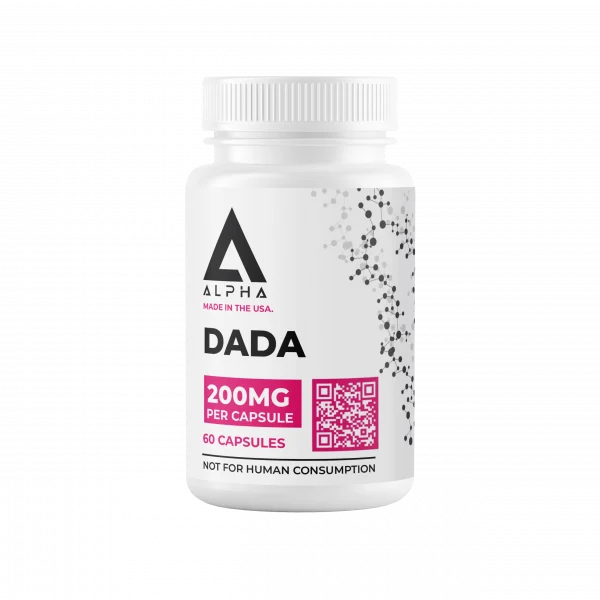
DADA is a capsule research product supplied at 200MG per capsule. It stands for diisopropylamine dichloroacetate, also called diisopropylammonium dichloroacetate. We sell it as finished capsules for lab research only. The capsules are made under standards and get internal QA review.
Bundle & save
Referral program · researchers save 10%, you earn 15% backThe compounds researchers order most, by verified order volume.
More ways to save
Volume pricing applies automatically from three bottles and reaches 20% at twenty. Larger runs, institutional supply and custom timelines get a quote.
Ask about bulkPublished product documentation
A certificate is not currently available for this product. Published reports remain available below; check the lot before using a report.
Verified test results
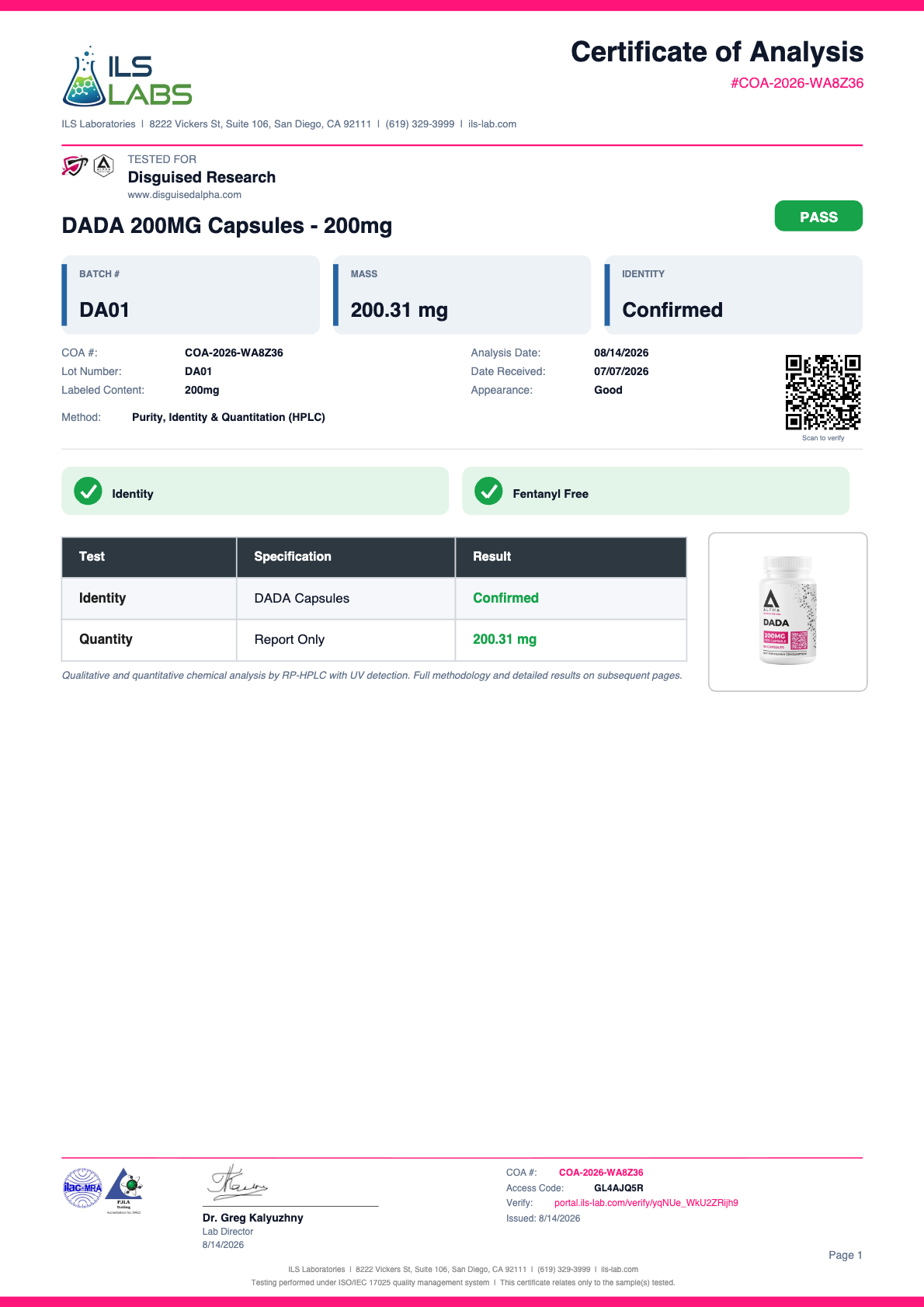
Each batch is analyzed by ILS Laboratories, an independent ISO/IEC 17025 accredited lab, before release. Below is the report for lot DA01, summarized from the certificate the lab published.
This lot ships under its own published certificate. Open any certificate below, exactly as the lab released it.
Side by side
Technical specifications
Peer-reviewed literature
Every reference below is a published, peer-reviewed record, linked to its PubMed entry. Provided for educational reference only - not product claims.
Important research notice
Not for human, veterinary, or food use. This product is sold exclusively for laboratory research purposes. It is not intended to diagnose, treat, cure, or prevent any disease, and has not been evaluated by the FDA.
All referenced publications and registries are sourced from peer-reviewed journals and official registries. They are provided for educational reference only and are not product claims.
By purchasing, you confirm you are a qualified researcher and will handle this product in accordance with all applicable laws and regulations.
Ready when you are
The lot on this page links to the signed certificate for that batch.
Encapsulated research material
DADA is a capsule research product supplied at 200MG per capsule. It stands for diisopropylamine dichloroacetate, also called diisopropylammonium dichloroacetate. We sell it as finished capsules for lab research only. The capsules are made under standards and get internal QA review. We do not use a 3PL. Our own team inspects, packs and ships every order.
| Compound | DADA |
|---|---|
| Strength | 200MG per capsule |
| Format | finished capsule research product |
| Formula | C₈H₁₇Cl₂NO₂ |
| Molecular weight | 230.13 g/mol |
DADA is a 1:1 salt of the base diisopropylamine and dichloroacetic acid. Its anion is dichloroacetate. That is the same anion as in sodium dichloroacetate (DCA).
Published work uses DADA as a PDK4 inhibitor and a metabolic tool compound. PDK stands for pyruvate dehydrogenase kinase. These kinases turn down the mitochondrial pyruvate dehydrogenase complex. They do this by adding phosphate to it (Kato et al., 2007). Each line below names the model.
| Enzyme assays | With recombinant human kinases, DADA inhibited PDK4 and PDK2. It did so at concentrations close to those of DCA (Yamane et al., 2014). |
|---|---|
| Cell culture | A team tested each half of the salt on its own. They used normal human keratinocytes, a type of skin cell. The dichloroacetate half was active. The amine half was not (Kitamura et al., 1999). |
The DADA research guide sorts the full PubMed record by model.
Finished capsules need close checks on consistency, production standards and records. We use capsule production, product review and internal QA. We do not handle finished capsules as generic white-label stock.
This is part of a larger quality system. It covers supplier accountability, sourcing standards, product records, internal QA and proper storage. We oversee each order from intake to final shipment.
Retain the product label and lot number with the research record. Review the matching certificate of analysis for test coverage and reported results. Identity, analytical purity, measured content, sterility and endotoxin testing are distinct assessments; one does not establish the others.
Follow the supplied label and your laboratory’s validated handling and storage procedures. Record the vehicle, concentration and preparation date where relevant. Dry-material stability does not establish the shelf life of a prepared solution.
It is the stated quantity per unit, separate from the number of units in the bottle. A purity percentage is not a measurement of milligrams per capsule or tablet. Use the matching lot report for the measurements actually performed.
Open the linked certificate for the assigned lot or use the COA portal. Check sample identity, methods, date and reported measurements. A report for another lot or formulation is not a substitute.
DADA is the 1:1 salt of diisopropylamine and dichloroacetic acid, C₈H₁₇Cl₂NO₂ at 230.13 g/mol as this page lists, so its anion is dichloroacetate, the same anion as in sodium dichloroacetate (DCA). When the two components were tested separately in normal human keratinocyte cultures, dichloroacetate was active and diisopropylamine was not.
Published work describes it as a pyruvate dehydrogenase kinase 4 (PDK4) inhibitor. Pyruvate dehydrogenase kinases downregulate the mitochondrial pyruvate dehydrogenase complex by phosphorylating it, and with recombinant human enzymes DADA's half-maximal inhibitory concentrations were 50.9 µM for PDK4 and 636.0 µM for PDK2, close to sodium dichloroacetate's 57.8 and 676.0 µM.
Not exactly. FDA states that "there has been no identity established for a substance characterized by the name pangamic acid (or 'vitamin B-15')". A 1982 paper described diisopropylamine dichloroacetate as the active component of many pangamic acid formulations, and PubChem's record named pangamic acid is a different molecule, an ester of gluconic acid and N,N-dimethylglycine.
Drugs@FDA lists no application for it: an openFDA search on 13 October 2026 returned none naming diisopropylamine dichloroacetate or dichloroacetate as an active ingredient. FDA's Compliance Policy Guide Sec. 457.100, which does not name the salt, states that "pangamic acid has no approved new drug application".
The current certificate is matched to the selected product option and assigned shipping batch.
Enable JavaScript to view the certificate for your selected option.
We share visit and purchase data with advertising partners to measure and show ads. Some US state laws, including California's, call that a sale or sharing of personal information. You can turn it off for this browser.
Ad sharing is on in this browser.
Saved in this browser only. For your account or other devices, email support@disguisedalpha.com. Privacy Policy