Up to20%OFF
Bulk Orders 20+ bottles
Volume pricing applies automatically from three bottles and reaches 20% at twenty. Larger runs, institutional supply and custom timelines get a quote.
Ask about bulk
Neurocognitive Research
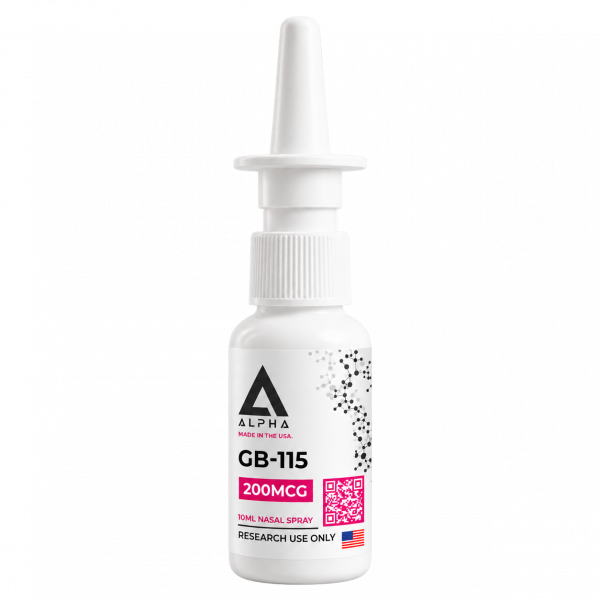
GB-115 Aerosol Spray is a research spray. Each 10ML bottle holds 20MG of GB-115 in total. The label lists 200MCG per spray, with about 100 sprays per bottle. You may also see the compound written as GB 115 or GB115.
Bundle & save
Referral program · researchers save 10%, you earn 15% backThe compounds researchers order most, by verified order volume.
More ways to save
Volume pricing applies automatically from three bottles and reaches 20% at twenty. Larger runs, institutional supply and custom timelines get a quote.
Ask about bulkShipping batch NASALSPRAY
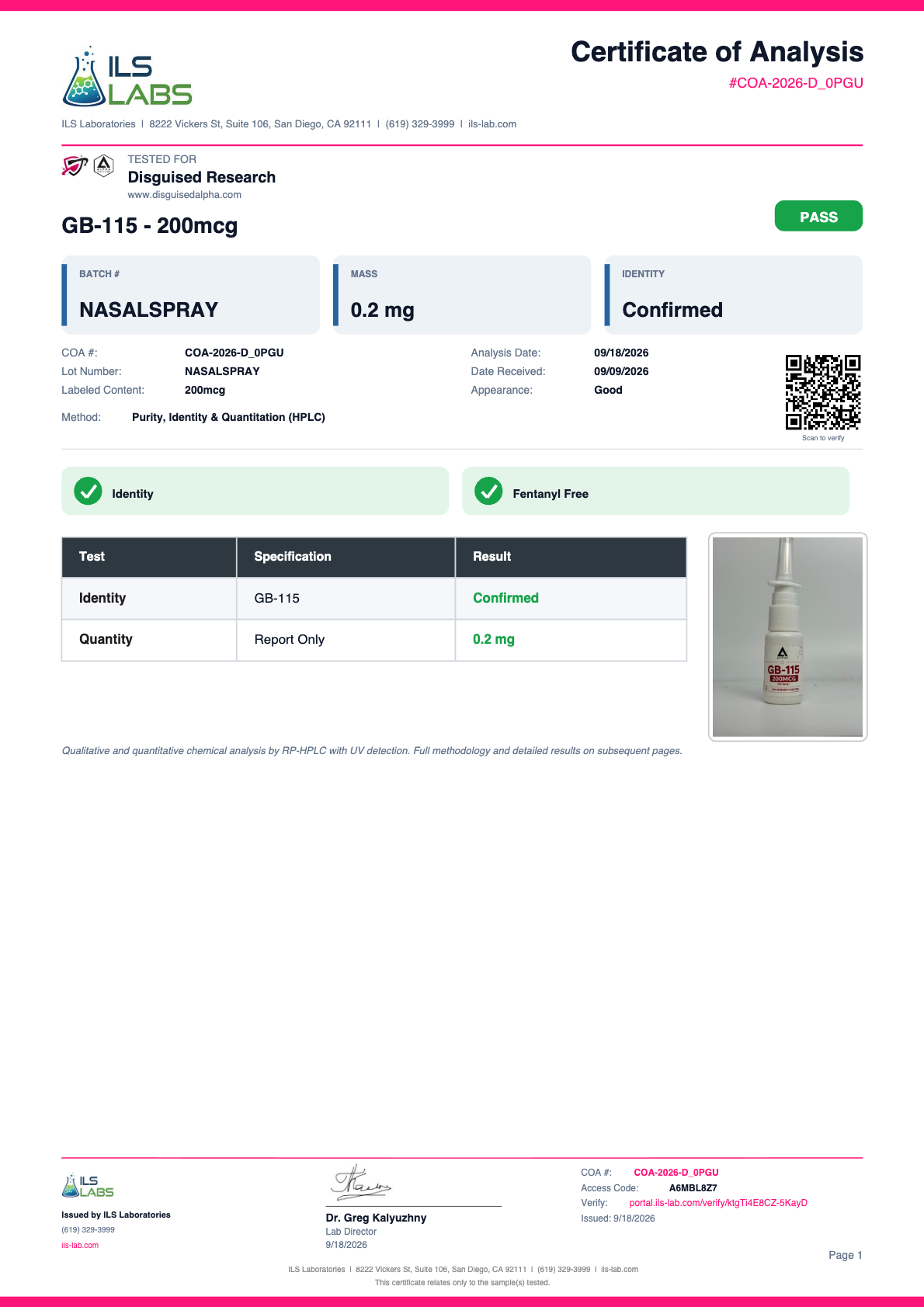
Open the certificate matched to this shipping batch.
Verified test results
Each batch is analyzed by ILS Laboratories, an independent ISO/IEC 17025 accredited lab, before release. Below is the report for lot NASALSPRAY, summarized from the certificate the lab published.
This lot ships under its own published certificate. Open any certificate below, exactly as the lab released it.
Side by side
Technical specifications
Peer-reviewed literature
Every reference below is a published, peer-reviewed record, linked to its PubMed entry. Provided for educational reference only - not product claims.
Important research notice
Not for human, veterinary, or food use. This product is sold exclusively for laboratory research purposes. It is not intended to diagnose, treat, cure, or prevent any disease, and has not been evaluated by the FDA.
All referenced publications and registries are sourced from peer-reviewed journals and official registries. They are provided for educational reference only and are not product claims.
By purchasing, you confirm you are a qualified researcher and will handle this product in accordance with all applicable laws and regulations.
Ready when you are
The lot on this page links to the signed certificate for that batch.
Aerosol research preparation
GB-115 Aerosol Spray is a research spray. Each 10ML bottle holds 20MG of GB-115 in total. The label lists 200MCG per spray, with about 100 sprays per bottle. You may also see the compound written as GB 115 or GB115.
It is made for controlled lab studies of neuropeptide pathways, CNS signaling and peptide-fragment biology. Labs also use it in neurochemical response systems, stress-response pathways and models of how nerve cells communicate.
| Compound | GB-115 |
|---|---|
| Labeled strength | 200MCG per spray |
| Spray count | about 100 sprays |
| Total volume | 10ML |
| Total content | 20MG GB-115 |
| Format | aerosol research spray |
GB-115 is a modified dipeptide. Glycine and L-tryptophan amide are joined by a peptide bond, with a 6-phenylhexanoyl group on one end. Its formula is C₂₅H₃₀N₄O₃, and its molecular weight is 434.5 g/mol.
It comes from a dipeptide design program at the V. V. Zakusov Institute of Pharmacology in Moscow. Its developers built it on the structure of cholecystokinin-4 (CCK-4), a natural four-amino-acid peptide (Gudasheva et al., 2007). They describe it as an antagonist of central cholecystokinin receptors (Kolik et al., 2003).
GB-115 is studied in lab models of neuropeptide signaling and CNS pathways. Research also covers peptide-fragment activity, nerve cell communication and neurochemical response systems. Most published work used mice and rats, and nearly all of it comes from the institute that made it. The GB-115 research guide lists the key studies and their models.
In the lab, peptide signals are one way to study how nerve cells talk to each other. They also matter in stress-response models. And they shape studies of how the CNS is regulated and how cells respond through receptors.
The clearly labeled spray suits studies of how GB-115 acts on these pathways. It also fits neuropeptide comparison models, CNS signaling systems and peptide-fragment research.
| Unopened | store at room temperature, 15 to 25°C. Protect from light, and do not freeze. |
|---|---|
| After opening | refrigerate at 2 to 8°C. Keep the bottle upright, closed and out of the light. |
Each lot has its own certificate of analysis. Find the lot code on your label, then open the matching report in the COA portal. The measured content on the certificate can differ from the label, so use the measured value for quantitative work. A purity figure and a measured amount are not the same measure. For questions about a lot or a report, contact Disguised Alpha.
Retain the product label and lot number with the research record. Review the matching certificate of analysis for test coverage and reported results. Identity, analytical purity, measured content, sterility and endotoxin testing are distinct assessments; one does not establish the others.
Follow the supplied label and your laboratory’s validated handling and storage procedures. Record the vehicle, concentration and preparation date where relevant. Dry-material stability does not establish the shelf life of a prepared solution.
Concentration is the stated amount per mL; total content also depends on the container volume. A per-spray amount requires a verified pump output and must not be inferred from concentration alone. Check each component separately for a blend.
Open the linked certificate for the assigned lot or use the COA portal. Check sample identity, methods, date and reported measurements. A report for another lot or formulation is not a substitute.
It is a modified dipeptide: glycine and L-tryptophan amide joined by a peptide bond, with a 6-phenylhexanoyl group capping the N-terminus. Its developers describe it as a dipeptide analog of cholecystokinin-4 (CCK-4), and a 2018 review from their institute calls it a tripeptoid analog. The formula this page lists, C₂₅H₃₀N₄O₃ at 434.5 g/mol, matches PubChem's record.
Its developers describe it as a retro analog of CCK-4 and an antagonist of central cholecystokinin receptors, and a 2012 mouse and rat study concluded that CCK-4 and GB-115 share a pharmacological target. The receptor subtype is not settled: a 2007 paper from the same group calls it a CCK2 antagonist, and a 2025 primate paper describes CCK1 antagonism.
The V. V. Zakusov Institute of Pharmacology in Moscow, in the same dipeptide drug-design program that produced Noopept. A 2007 paper from the program built a series of dipeptides on the structure of the tetrapeptide CCK-4 and chose GB-115 for further study, and 2013 NMR work proposed a beta-II turn as its active conformation.
In animals, mostly mice and rats: behavioral tests, opioid-interaction studies, ethanol-access and inflammation models, immune studies and pharmacokinetic work. Rabbits were also used in 2010 preclinical testing, and four male rhesus monkeys in a 2025 study. This covers the animal research only, not the full published record.
The current certificate is matched to the selected product option and assigned shipping batch.
Enable JavaScript to view the certificate for your selected option.
We share visit and purchase data with advertising partners to measure and show ads. Some US state laws, including California's, call that a sale or sharing of personal information. You can turn it off for this browser.
Ad sharing is on in this browser.
Saved in this browser only. For your account or other devices, email support@disguisedalpha.com. Privacy Policy