Up to20%OFF
Bulk Orders 20+ vials
Volume pricing applies automatically from three vials and reaches 20% at twenty. Larger runs, institutional supply and custom timelines get a quote.
Ask about bulk
Gut & Barrier Research
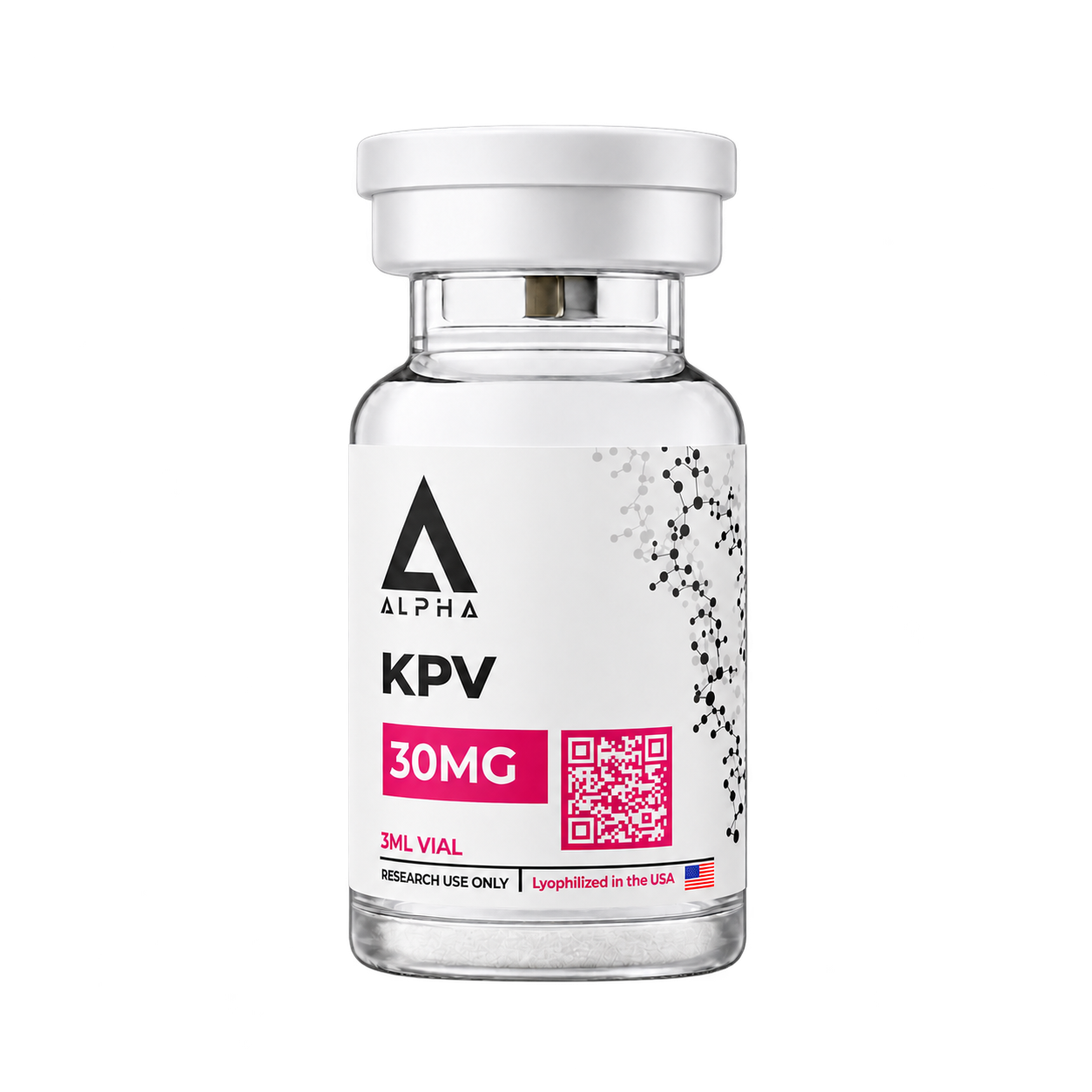
KPV is a research tripeptide studied in models involving inflammatory signaling, immune-response regulation, skin barrier biology, gastrointestinal research, and tissue-response pathways.
Bundle & saveApplies to every size
Referral program · researchers save 10%, you earn 15% backThe compounds researchers order most, by verified order volume.
More ways to save
Volume pricing applies automatically from three vials and reaches 20% at twenty. Larger runs, institutional supply and custom timelines get a quote.
Ask about bulkSelect a product option
Choose a size to check its batch and certificate. Published reports remain available below; check the lot before using a report.
Verified test results
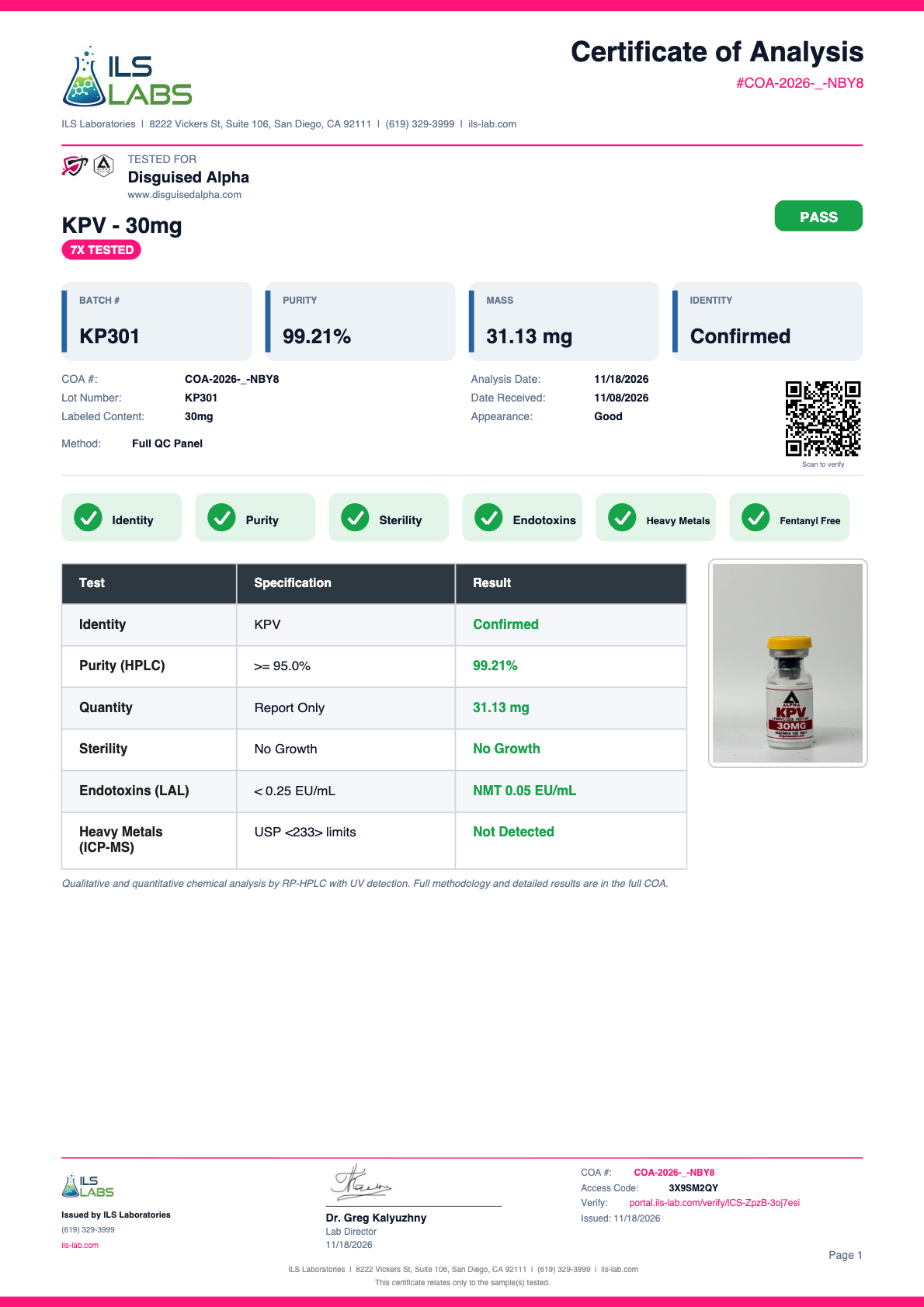
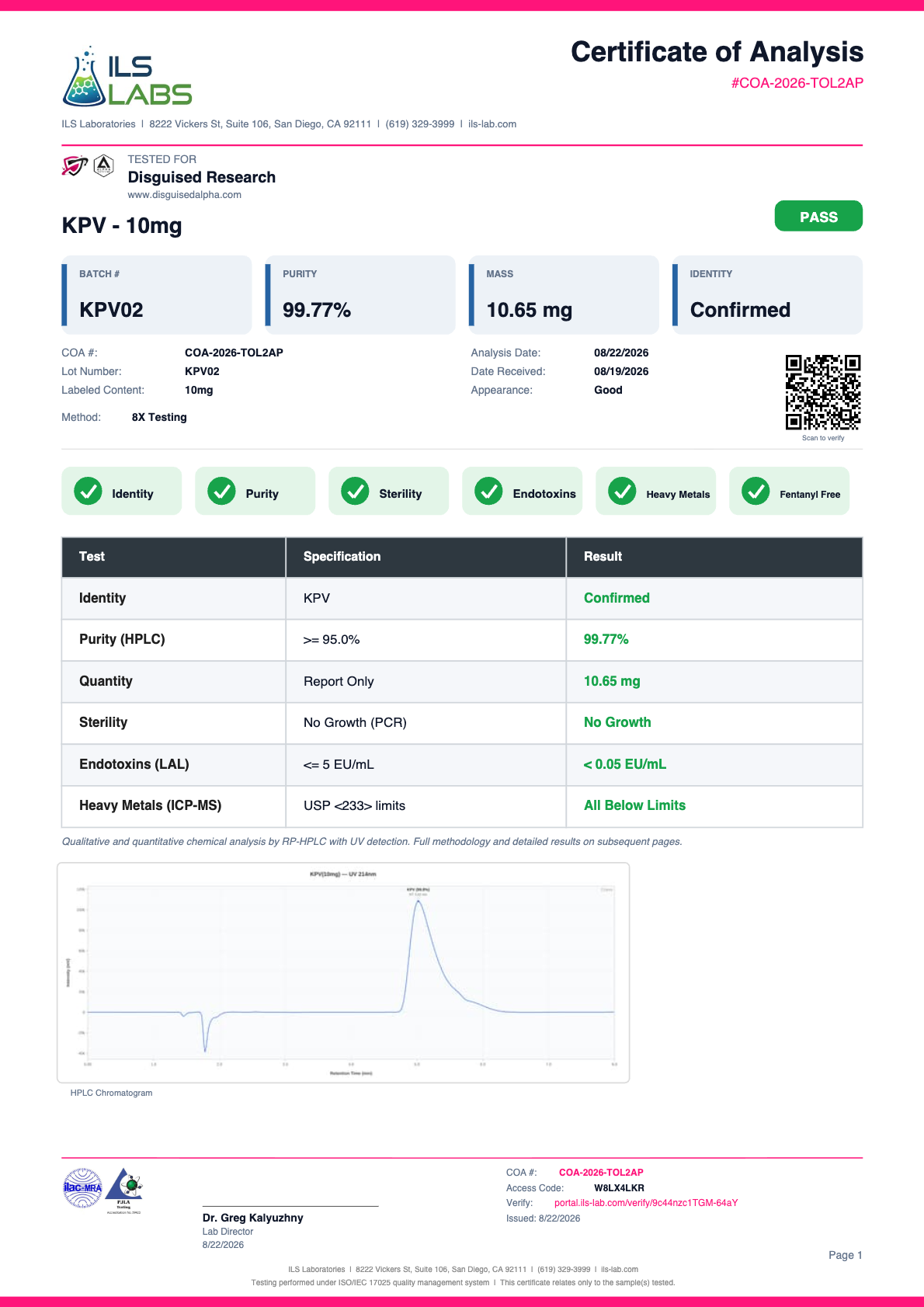
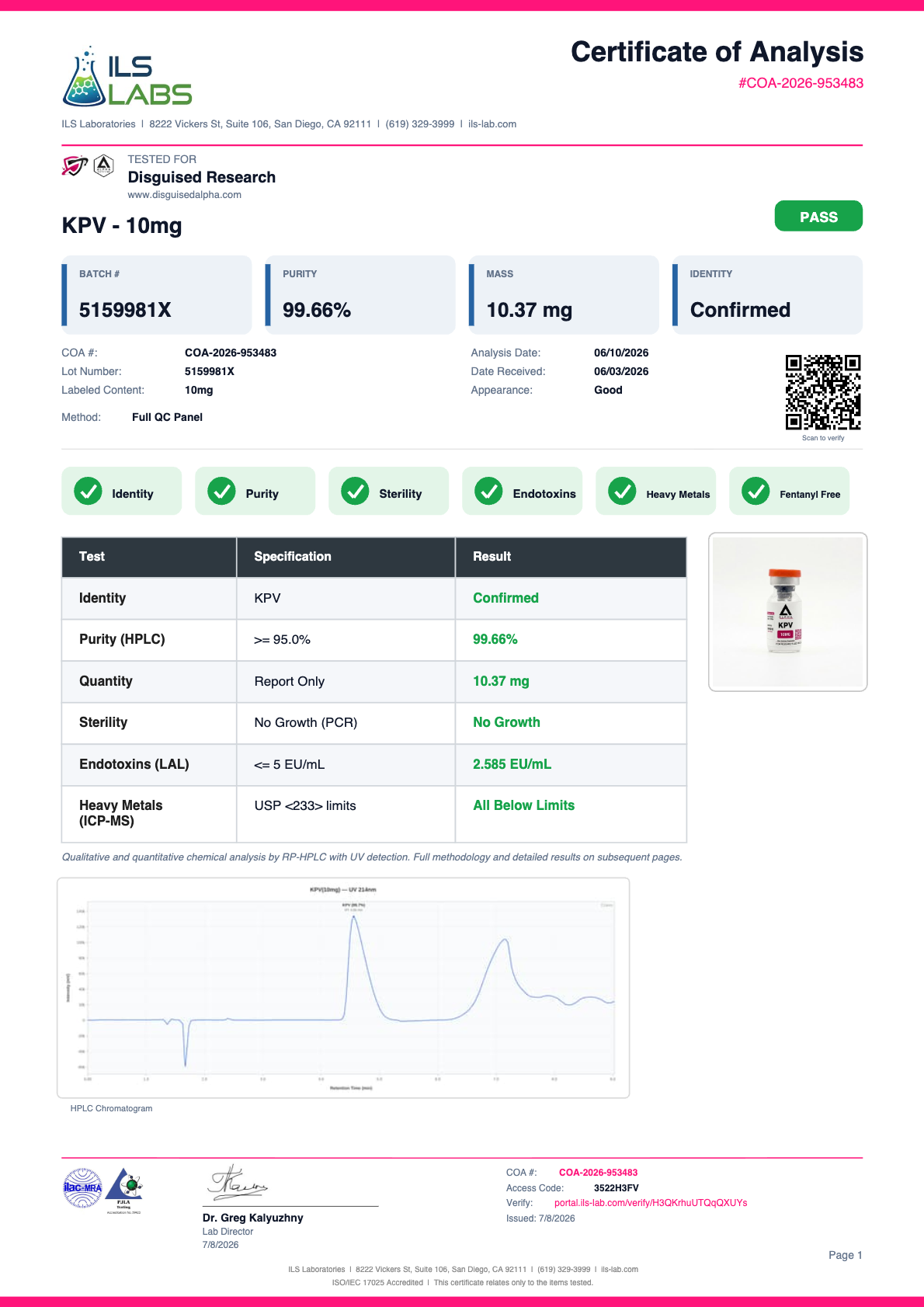
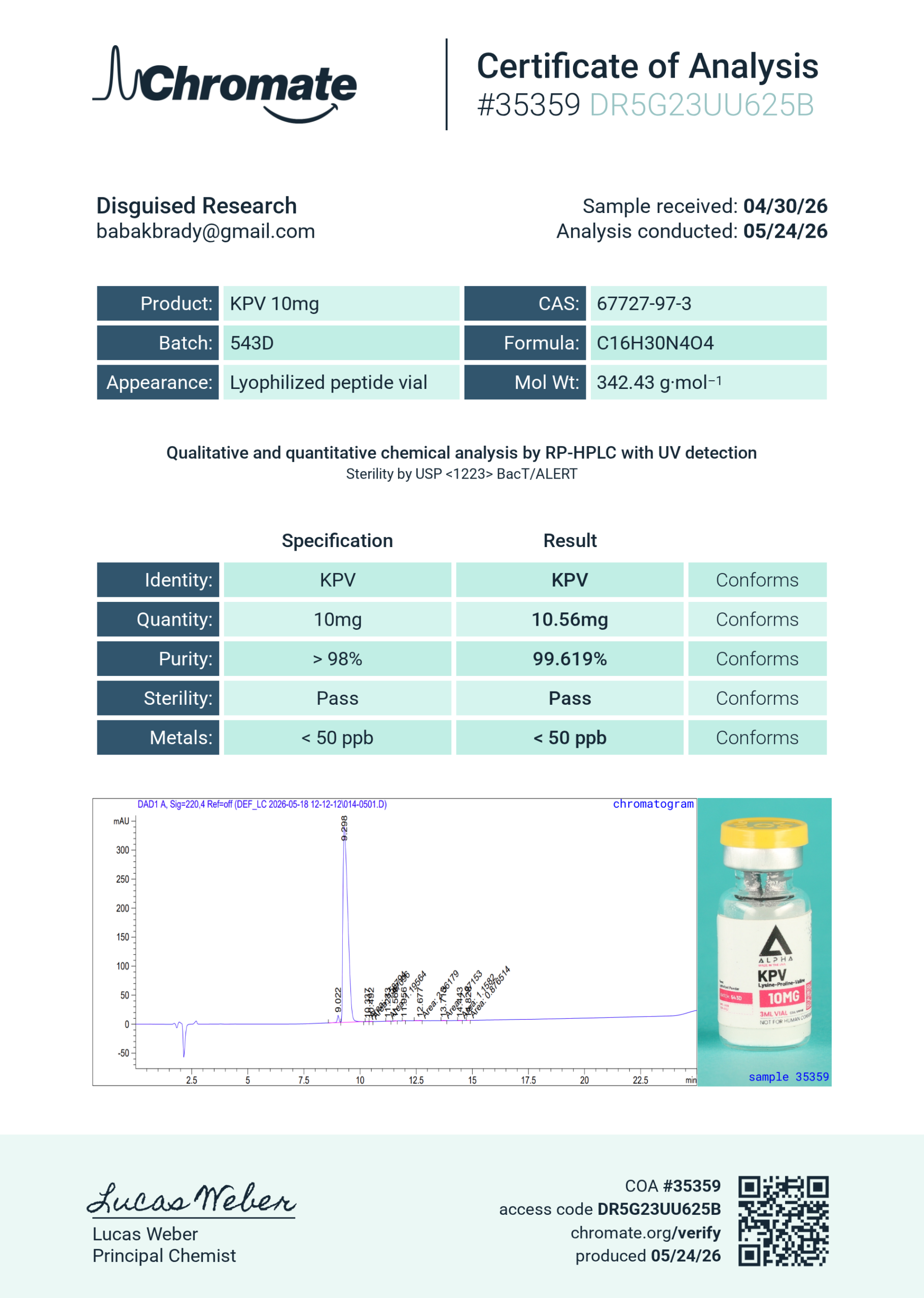
Each batch is analyzed by an independent third-party laboratory before release. The lots below were tested by Chromate and ILS Laboratories. Below is the report for lot KP301, summarized from the certificate the lab published.
Every lot we have published for this compound, grouped by the lab that tested it, newest first. Open any certificate below, exactly as the lab released it.
Side by side
Technical specifications
Peer-reviewed literature
Every reference below is a published, peer-reviewed record, linked to its PubMed entry. Provided for educational reference only - not product claims.
Important research notice
Not for human, veterinary, or food use. This product is sold exclusively for laboratory research purposes. It is not intended to diagnose, treat, cure, or prevent any disease, and has not been evaluated by the FDA.
All referenced publications and registries are sourced from peer-reviewed journals and official registries. They are provided for educational reference only and are not product claims.
By purchasing, you confirm you are a qualified researcher and will handle this product in accordance with all applicable laws and regulations.
Ready when you are
The lot on this page links to the signed certificate for that batch.
Lyophilized research material
A three-amino-acid peptide studied for how peptide transport and inflammatory signaling interact in epithelial and immune-cell models.
KPV is lysine-proline-valine, a terminal sequence associated with alpha-MSH. It is distinct from the full hormone and from melanotan analogs.
The PepT1 study used intestinal cell models, immune cells and mouse colitis models. Its contribution is a mechanistic transport/signaling link.
Published findings describe the materials and conditions in the cited studies. Receptor or cell-pathway evidence does not establish safety or efficacy of this finished research product. Match the supplied identity and format to the current label and batch documentation.
KPV is a research tripeptide studied in models involving inflammatory signaling, immune-response regulation, skin barrier biology, gastrointestinal research, and tissue-response pathways.
Disguised Alpha KPV is made for researchers who expect more than a generic peptide listing. Each batch is reviewed through our internal quality assurance process, supported by third-party analytical testing, and fulfilled directly by our in-house team.
Studied in models involving inflammatory signaling, immune regulation, and tissue-response pathways.
Relevant to research involving skin barrier function, gastrointestinal biology, and epithelial response.
KPV is studied for its relevance to immune and inflammatory signaling research. As a short tripeptide sequence, it is commonly examined in models involving epithelial barrier response, skin biology, gastrointestinal environments, and tissue-level inflammatory pathways.
Its research profile makes it especially relevant for studies focused on barrier integrity, immune modulation, inflammatory response, gut-related pathway models, skin research, and tissue homeostasis.
Primary research relevant to the named compound or clearly identified component is linked below. Experimental results depend on identity, model and formulation.
Examined peptide uptake and inflammatory signaling. The paper concerns KPV in its study systems, not this commercial preparation.
Retain the product label and lot number with the research record. Review the matching certificate of analysis for test coverage and reported results. Identity, analytical purity, measured content, sterility and endotoxin testing are distinct assessments; one does not establish the others.
Follow the supplied label and your laboratory’s validated handling and storage procedures. Record the vehicle, concentration and preparation date where relevant. Dry-material stability does not establish the shelf life of a prepared solution.
The listed milligrams refer to material per vial, not concentration or administration instructions. A prepared solution has its own concentration and stability requirements. Verify the exact selected option and shipping lot.
Open the linked certificate for the assigned lot or use the COA portal. Check sample identity, methods, date and reported measurements. A report for another lot or formulation is not a substitute.
The references describe the materials and conditions used by their authors. They do not establish that this commercial formulation was tested. For blends, evidence on an individual component does not validate the finished mixture or establish synergy.
Alpha-melanocyte-stimulating hormone (alpha-MSH). KPV, the tripeptide Lys-Pro-Val, is the C-terminal end of alpha-MSH, residues 11 to 13 of that 13-residue peptide, which is itself derived from proopiomelanocortin. Papers since 1984 call it alpha-MSH 11-13, and PubChem lists it as C₁₆H₃₀N₄O₄ at 342.43 g/mol, matching the formula and molecular weight on this page.
Unlikely, as studied. In RAW 264.7 macrophage-like cells, KPV did not compete for melanocortin-1 receptor binding even at 1 mM and did not raise cyclic AMP, and a 2003 mouse peritonitis study concluded it is unlikely to act through melanocortin receptors. In human intestinal epithelial and T cell lines, it entered cells through the peptide transporter PepT1.
Not in any clinical trial we found. A PubMed search on 14 October 2026 for KPV, Lys-Pro-Val, lysine-proline-valine or alpha-MSH 11-13 in titles and abstracts found no record indexed as a clinical trial or clinical study. Published models include cell lines, mice, rats and rabbits.
Disguised Alpha sells KPV here for laboratory research only, as powder lyophilized in the USA. Each published lot's certificate of analysis appears on this page under the lab that tested it, ILS Laboratories or Chromate. Orders ship from the US West Coast, with tracked delivery on every order.
The current certificate is matched to the selected product option and assigned shipping batch.
Enable JavaScript to view the certificate for your selected option.
We share visit and purchase data with advertising partners to measure and show ads. Some US state laws, including California's, call that a sale or sharing of personal information. You can turn it off for this browser.
Ad sharing is on in this browser.
Saved in this browser only. For your account or other devices, email support@disguisedalpha.com. Privacy Policy