Up to20%OFF
Bulk Orders 20+ bottles
Volume pricing applies automatically from three bottles and reaches 20% at twenty. Larger runs, institutional supply and custom timelines get a quote.
Ask about bulk
Neurocognitive Research
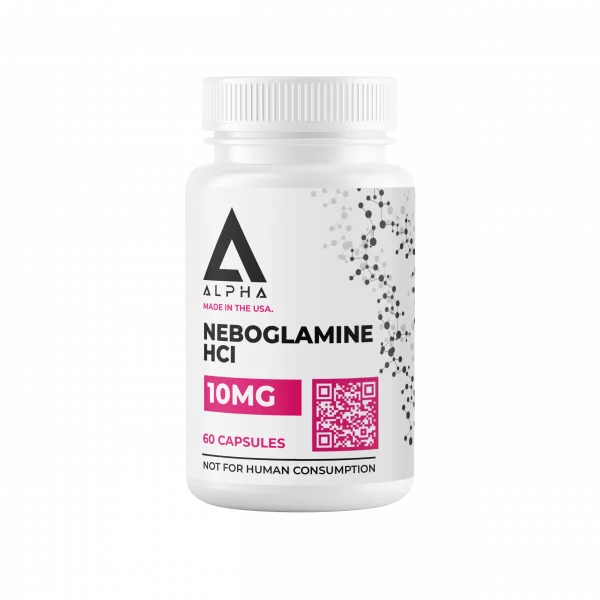
Neboglamine HCl is a capsule research product with 10MG per capsule and 60 capsules per bottle, or 600MG in total. It is neboglamine hydrochloride, sold for lab research only. Early papers name it by its code, CR 2249. Its research centers on the NMDA receptor and glutamate signaling.
Bundle & save
Referral program · researchers save 10%, you earn 15% backThe compounds researchers order most, by verified order volume.
More ways to save
Volume pricing applies automatically from three bottles and reaches 20% at twenty. Larger runs, institutional supply and custom timelines get a quote.
Ask about bulkPeer-reviewed literature
Every reference below is a published, peer-reviewed record, linked to its PubMed entry. Provided for educational reference only - not product claims.
Important research notice
Not for human, veterinary, or food use. This product is sold exclusively for laboratory research purposes. It is not intended to diagnose, treat, cure, or prevent any disease, and has not been evaluated by the FDA.
All referenced publications and registries are sourced from peer-reviewed journals and official registries. They are provided for educational reference only and are not product claims.
By purchasing, you confirm you are a qualified researcher and will handle this product in accordance with all applicable laws and regulations.
Disguised Alpha · Lab records
Match the product and lot on your label to the original laboratory report.
Shipping batch NG01
No published certificate is currently matched to this shipping batch.
Encapsulated research material
Neboglamine HCl is a capsule research product with 10MG per capsule and 60 capsules per bottle, or 600MG in total. It is neboglamine hydrochloride, sold for lab research only. Early papers name it by its code, CR 2249. Its research centers on the NMDA receptor and glutamate signaling.
| Compound | Neboglamine HCl (CR 2249) |
|---|---|
| Strength | 10MG per capsule |
| Count | 60 capsules per bottle |
| Total content | 600MG per bottle |
| Format | finished capsule research product |
| Formula | C₁₃H₂₅ClN₂O₃ (hydrochloride) |
| Molecular weight | 292.80 g/mol for the salt, 256.34 g/mol for the free base |
Neboglamine is a synthetic small molecule built on glutamic acid. One acid group is joined as an amide to 4,4-dimethylcyclohexylamine. The side-chain acid stays free. The molecule has one stereocenter, in the S configuration. The HCl salt changes the molecular weight used in calculations, not the parent structure.
The first two PubMed records, from 1996 and 1997, come from Rotta Research Laboratorium in Monza, Italy. A 2010 paper calls it "a functional modulator of the glycine site" on the NMDA receptor (Chiusaroli et al., 2010).
The published record is small. A PubMed search on 13 October 2026 found four records for neboglamine. A search for its code added a fifth. All five are rodent or brain tissue studies from 1996 to 2010.
| NMDA receptor assays | In rat hippocampal slices, it raised the maximum effect of glycine. It did not significantly change glycine's potency. It also raised MK-801 binding. The developers read this as action at a separate allosteric site (Lanza et al., 1997). |
|---|---|
| Kynurenate test | In rat brain slices, it kept kynurenate from blocking NMDA-evoked release. Its mirror-image form, CR 2361, did not (Pittaluga et al., 1997). |
| Rat forebrain | It raised the number of Fos-positive cells in the prefrontal cortex and nucleus accumbens. Fos is a marker of active neurons. The pattern closely matched that of D-serine, a natural agonist at the NMDA glycine site (Chiusaroli et al., 2010). |
The neboglamine research guide sums up all five records.
A capsule research product needs more than a compound name and a bottle. Strength, capsule look, records, labels, handling and storage all matter.
We review it as a complete capsule product. We check capsule consistency, the 10MG strength label, the records and the finished bottle. Each product gets internal QA before release.
Retain the product label and lot number with the research record. Review the matching certificate of analysis for test coverage and reported results. Identity, analytical purity, measured content, sterility and endotoxin testing are distinct assessments; one does not establish the others.
Follow the supplied label and your laboratory’s validated handling and storage procedures. Record the vehicle, concentration and preparation date where relevant. Dry-material stability does not establish the shelf life of a prepared solution.
It is the stated quantity per unit, separate from the number of units in the bottle. A purity percentage is not a measurement of milligrams per capsule or tablet. Use the matching lot report for the measurements actually performed.
Open the linked certificate for the assigned lot or use the COA portal. Check sample identity, methods, date and reported measurements. A report for another lot or formulation is not a substitute.
CR 2249 is the development code used for neboglamine in the earliest PubMed records, from Rotta Research Laboratorium in Monza, Italy, which selected it from a series of glutamic acid derivatives. Its mirror-image form was coded CR 2361, and PubChem also lists the code XY-2401 among neboglamine's synonyms.
A 2010 Rottapharm paper describes it as "a functional modulator of the glycine site on the N-methyl-D-aspartate (NMDA) receptor". In rat hippocampal slices it raised the efficacy of glycine's effect without significantly changing glycine's potency; in binding assays it increased [3H]MK-801 binding with positive cooperativity with glycine, which the 1997 developers read as probable action at a separate allosteric site.
Rodents and brain tissue. The five PubMed records for neboglamine or its code CR 2249 (searched 13 October 2026) used rat hippocampal slices and nerve terminals, receptor binding assays, rat forebrain and cortical tissue, hippocampal microdialysis in rats, behavioral tests in rats and mice, and slices of human cortex removed during neurosurgery, tested as tissue rather than in people.
It is neboglamine supplied as its hydrochloride salt: C₁₃H₂₅ClN₂O₃ at 292.80 g/mol, against C₁₃H₂₄N₂O₃ at 256.34 g/mol for the free base (PubChem). The salt changes the weight used in calculations, not the parent structure, and the PubMed abstracts do not say which form the studies used.
The current certificate is matched to the selected product option and assigned shipping batch.
Enable JavaScript to view the certificate for your selected option.
We share visit and purchase data with advertising partners to measure and show ads. Some US state laws, including California's, call that a sale or sharing of personal information. You can turn it off for this browser.
Ad sharing is on in this browser.
Saved in this browser only. For your account or other devices, email support@disguisedalpha.com. Privacy Policy