Up to20%OFF
Bulk Orders 20+ bottles
Volume pricing applies automatically from three bottles and reaches 20% at twenty. Larger runs, institutional supply and custom timelines get a quote.
Ask about bulk
Metabolic Research
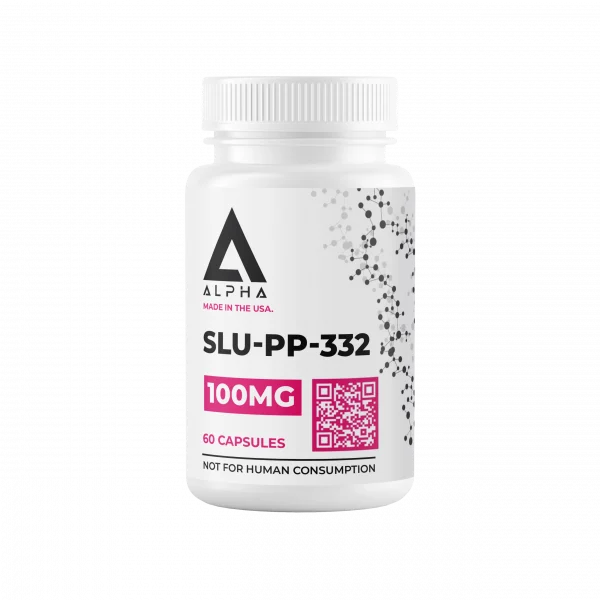
SLU-PP-332 is a synthetic small molecule used in lab research on the estrogen-related receptors (ERRs). It is an ERR agonist, which means it switches these receptors on. Labs study it in metabolic and exercise-response research. This listing is the 100 mg capsule format.
Bundle & save
Referral program · researchers save 10%, you earn 15% backThe compounds researchers order most, by verified order volume.
More ways to save
Volume pricing applies automatically from three bottles and reaches 20% at twenty. Larger runs, institutional supply and custom timelines get a quote.
Ask about bulkVerified test results
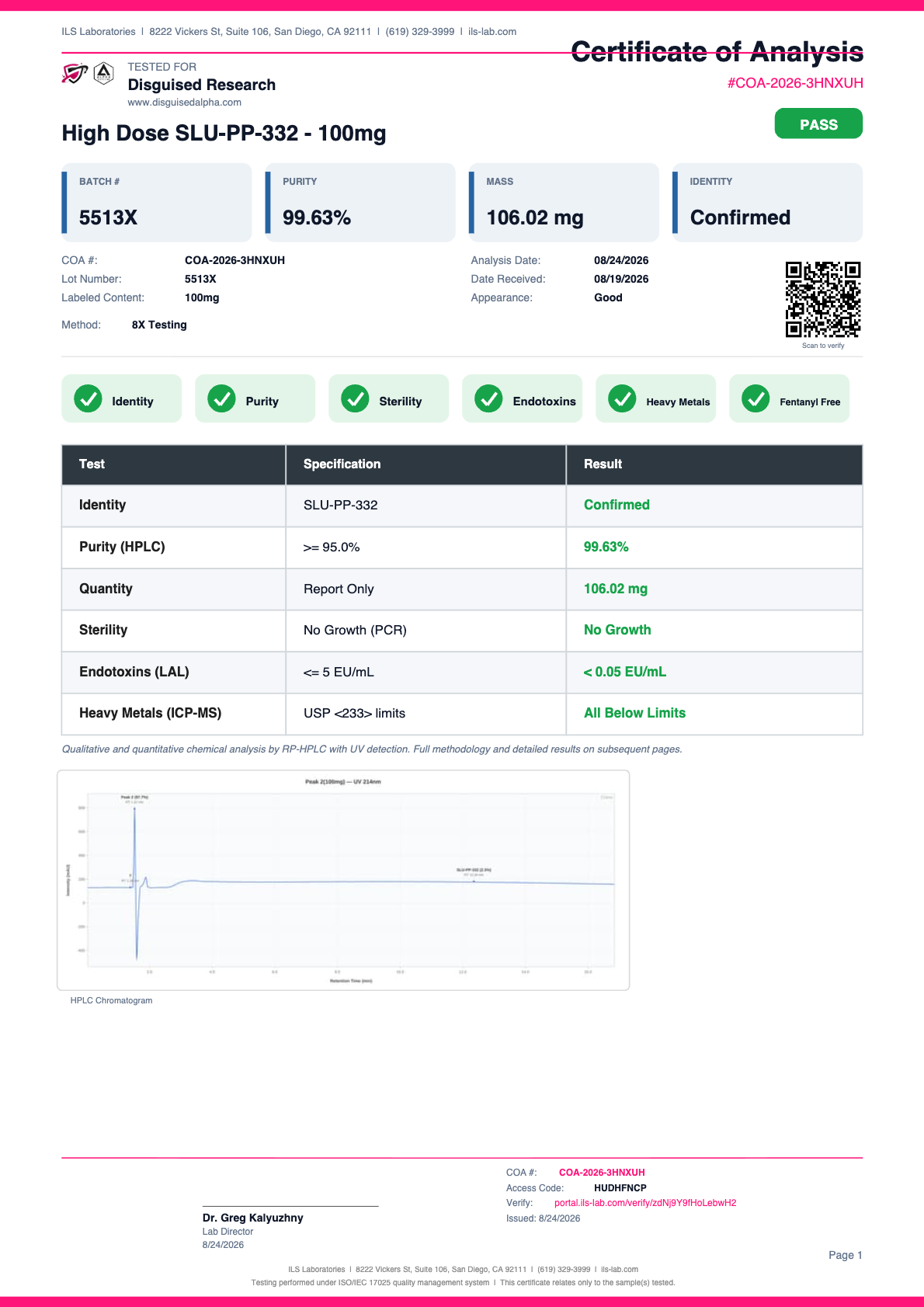
Each batch is analyzed by an independent third-party laboratory before release. The lots below were tested by Chromate and ILS Laboratories. Below is the report for lot 5513X, summarized from the certificate the lab published.
Every lot we have published for this compound, grouped by the lab that tested it, newest first. Open any certificate below, exactly as the lab released it.
Side by side
Technical specifications
Peer-reviewed literature
Every reference below is a published, peer-reviewed record, linked to its PubMed entry. Provided for educational reference only - not product claims.
Important research notice
Not for human, veterinary, or food use. This product is sold exclusively for laboratory research purposes. It is not intended to diagnose, treat, cure, or prevent any disease, and has not been evaluated by the FDA.
All referenced publications and registries are sourced from peer-reviewed journals and official registries. They are provided for educational reference only and are not product claims.
By purchasing, you confirm you are a qualified researcher and will handle this product in accordance with all applicable laws and regulations.
Ready when you are
The lot on this page links to the signed certificate for that batch.
Encapsulated research material
SLU-PP-332 is a synthetic small molecule used in lab research on the estrogen-related receptors (ERRs). It is an ERR agonist, which means it switches these receptors on. Labs study it in metabolic and exercise-response research. This listing is the 100 mg capsule format.
The label amount is the material in each capsule. It is not a recommendation for use. Searches also spell the name SLU PP 332 or slupp332. All of these name the same compound.
| Compound | SLU-PP-332 |
|---|---|
| Labeled content | 100 mg per capsule |
| Format | capsules for lab research |
| Molecular formula | C₁₈H₁₄N₂O₂ |
| Molecular weight | 290.3 g/mol |
| Container | a sealed plastic bottle, a sealed glass bottle or a resealable pouch, based on the batch |
SLU-PP-332 is not a peptide. It has no amino acids and no peptide bonds. It is an acylhydrazone, built from 4-hydroxybenzohydrazide and naphthalene-2-carbaldehyde. PubChem lists it as CID 5338394, and it is also known by the code SR9861.
Chemists at Saint Louis University and the Center for Clinical Pharmacology designed it from an older ERR agonist, GSK4716. They added a naphthalene group to raise its activity at ERR alpha. In cell assays it acts on all three ERRs: alpha, beta and gamma. It is most potent at ERR alpha (Billon et al., 2023).
All published work on SLU-PP-332 is preclinical. No human trial is indexed in PubMed, and it is not an approved drug. These are the main lines of work, each with its model:
| Muscle cells and mice | the 2023 study measured mitochondrial respiration in a mouse muscle cell line. It also measured muscle fiber types and treadmill running in mice (Billon et al., 2023). |
|---|---|
| Obesity models | a 2024 study measured energy expenditure, fat mass and insulin sensitivity in obese mice (Billon et al., 2024). |
| Heart failure model | a 2024 study tested SLU-PP-332 and SLU-PP-915 in a mouse pressure-overload model (Xu et al., 2024). |
| Aging kidney | a 2023 study looked at kidney and mitochondrial markers in mice aged 21 months (Wang et al., 2023). |
| Human cells in culture | a 2025 pilot study exposed muscle cells grown from surgical samples to the compound (Bonanni et al., 2025). These were cells in a dish, not people. |
| Analytical work | a sports drug-testing lab mapped how human liver fractions break it down (Möller et al., 2026). |
These papers explain why labs study the compound. They do not show how a finished capsule will perform in a given assay. Before you compare findings, check the material, the vehicle and the model in each paper. The SLU-PP-332 research guide has the full citations.
100 mg per capsule equals 100,000 mcg per capsule. That is 10 times the mass of a 10 mg capsule and 200 times the mass of a 500 mcg capsule. These are mass figures only. They say nothing about potency, absorption or biological effect.
A higher strength changes how much material sits in each unit. It does not make capsules the same as liquids, vials or blends. Compare the exact compound, format, amount per unit and pack count. For the full math, see SLU-PP-332 100 mg: strength, units and price comparisons.
The compound is also sold as Liquid SLU-PP-332 and as a non-DMSO liquid formula. Each format has its own specs and lot certificates. They are not interchangeable with these capsules.
Both came from the same research program, and both act on ERRs. Their chemistry differs, though. SLU-PP-332 is an acylhydrazone, while SLU-PP-915 is a thiophene amide with a boronic acid group. The SLU-PP-915 10 mg capsule listing has its own identity, specs and documents. The two products are not interchangeable.
A purity figure does not confirm 100 mg per capsule on its own. Purity and measured content answer different questions. A content figure must name the tested sample and use matching units before you compare it with the capsule label.
Primary research relevant to the named compound or clearly identified component is linked below. Experimental results depend on identity, model and formulation.
Examined a synthetic ERR agonist in cellular and animal systems. ERRs are estrogen-related nuclear receptors, distinct from classical estrogen receptors.
Retain the product label and lot number with the research record. Review the matching certificate of analysis for test coverage and reported results. Identity, analytical purity, measured content, sterility and endotoxin testing are distinct assessments; one does not establish the others.
Follow the supplied label and your laboratory’s validated handling and storage procedures. Record the vehicle, concentration and preparation date where relevant. Dry-material stability does not establish the shelf life of a prepared solution.
It is the stated quantity per unit, separate from the number of units in the bottle. A purity percentage is not a measurement of milligrams per capsule or tablet. Use the matching lot report for the measurements actually performed.
Open the linked certificate for the assigned lot or use the COA portal. Check sample identity, methods, date and reported measurements. A report for another lot or formulation is not a substitute.
The references describe the materials and conditions used by their authors. They do not establish that this commercial formulation was tested. For blends, evidence on an individual component does not validate the finished mixture or establish synergy.
The current certificate is matched to the selected product option and assigned shipping batch.
Enable JavaScript to view the certificate for your selected option.
We share visit and purchase data with advertising partners to measure and show ads. Some US state laws, including California's, call that a sale or sharing of personal information. You can turn it off for this browser.
Ad sharing is on in this browser.
Saved in this browser only. For your account or other devices, email support@disguisedalpha.com. Privacy Policy