
ATX-304, formerly described as O304, is a small molecule investigated in metabolic research involving AMPK. Its published evidence includes a short human proof-of-concept study and later work in a mouse model of liver disease. The chemical form and formulation of research material must be considered separately from those study findings.[1][2]
AMPK and metabolic research
AMPK is a cellular energy-regulation system. Research on its activation asks how cells change fuel use and energy storage. The 2018 O304 paper described activation across AMPK complexes and experiments on glucose handling and microvascular perfusion.[1]
“AMPK activator” describes a pharmacological research category. It does not establish a universal effect on body composition, exercise capacity or longevity. A pathway can influence several tissues, and the consequences depend on the experimental conditions.
Human and preclinical evidence
| Source | Study setting | Findings and limits |
|---|---|---|
| Steneberg et al., 2018 [1] | Mouse studies and a phase IIa proof-of-concept trial in people with type 2 diabetes receiving metformin | Reported changes in glucose-related measures and microvascular perfusion. A short, disease-specific study is not broad evidence for healthy users. |
| Holm et al., 2025 [2] | Male mice in a progressive fatty-liver model | Examined liver lipids, oxidative stress and metabolic switching. This was preclinical liver-disease research. |
The 2025 paper described changes in hepatic lipid handling and reduced oxidative-stress and disease-associated findings in the tested mice. Its authors called for further exploration of clinical translation. Mouse findings do not establish treatment of metabolic dysfunction-associated steatotic liver disease in humans.[2]
Chemical form and interpretation
DA’s product is listed as ATX-304 sodium salt. A salt designation is part of the material specification, not a cosmetic naming choice. Molecular mass, reference standards and the basis on which content is reported can affect a comparison. This article makes no sodium-salt-to-parent conversion or bioequivalence claim.
Before comparing a supplied material with a publication, check the actual chemical form, formulation and analytical method. A shared name or a matching pathway does not establish identical exposure, assay performance or clinical behavior. Findings for a single compound also should not be assigned to a blend containing it.
The cited studies do not establish a self-administration protocol or the long-term safety of DA’s capsule formulation. Research interest and clinical validation are separate stages of evidence.
Disguised Alpha COAs and batch documentation
- ATX-304 — lot FX35, Chromate report #35973 · analysis dated June 12, 2026. Open certificate image.
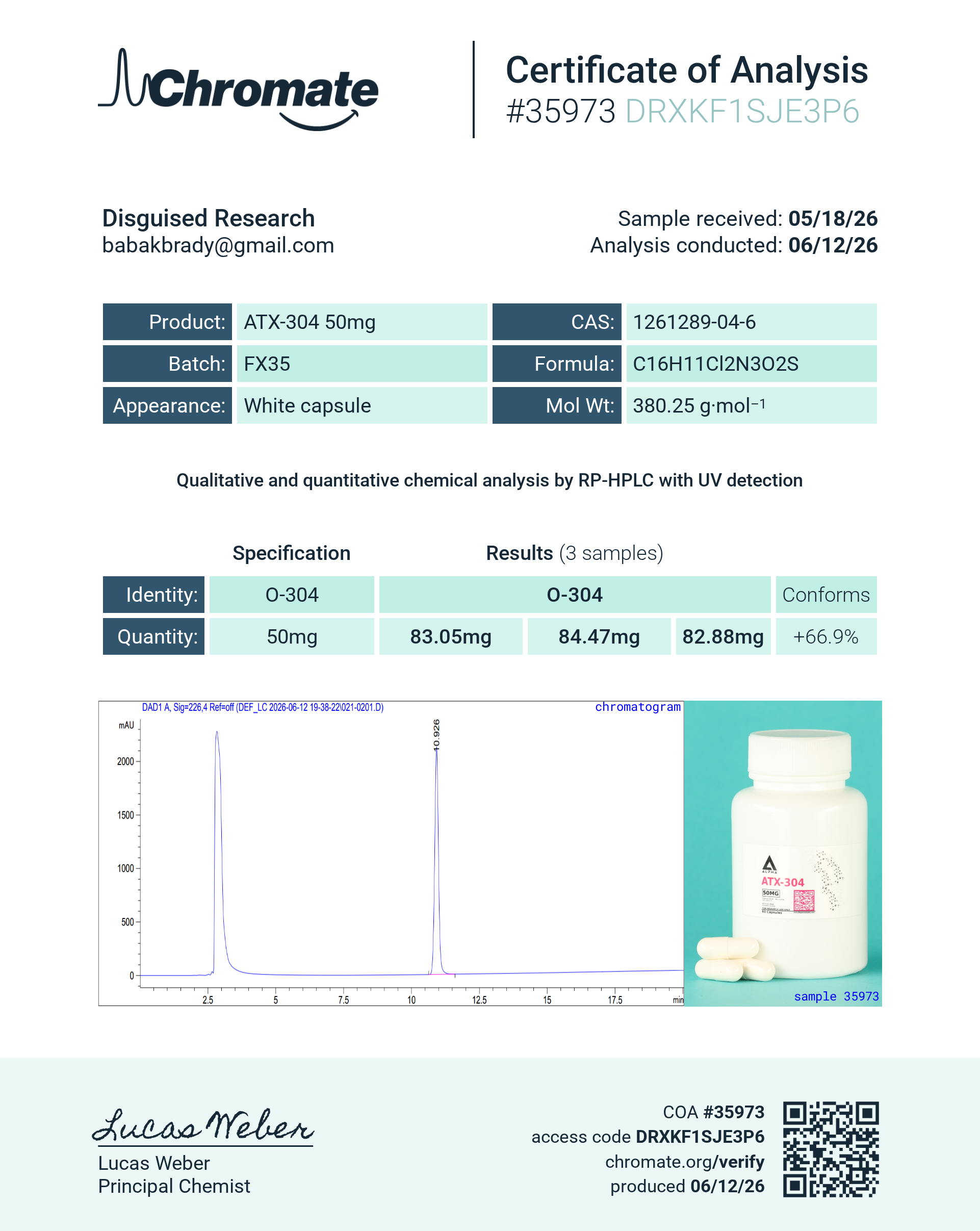
Form and content note: the displayed report identifies O-304 and lists three quantity results of 83.05 mg, 84.47 mg and 82.88 mg against a 50 mg specification. It does not explicitly identify a sodium salt. These reported values should not be relabeled as a verified salt-specific or parent-equivalent assay. Request clarification of chemical form and assay basis before treating this report as verification of the sodium-salt specification.
DA sodium-salt specification record · COA portal · Request documentation clarification.
A COA concerns the sample tested and the methods reported. It is not a clinical trial, regulatory approval or proof of safety for human use. Current availability and shipping lots can change.
References
- Steneberg P, et al. (2018). O304, glucose homeostasis and microvascular perfusion in mice and type 2 diabetes patients. JCI Insight 3:e99114. DOI: 10.1172/jci.insight.99114.
- Holm E, et al. (2025). AMPK activator ATX-304 reduces oxidative stress and improves MASLD via metabolic switching. JCI Insight 10:e179990. DOI: 10.1172/jci.insight.179990.
References are selected primary studies and publication-status records, not a systematic review. Study findings are attributed to their authors; the COAs are supplier-associated batch documentation.
Publisher disclosure: Disguised Alpha sells research materials discussed on this page. This supplier-published reference is not independent clinical guidance. Materials are offered for laboratory research only, not human consumption. No dosing or treatment recommendation is provided.