
Bromantane is an adamantane-derived small molecule investigated in neuropharmacology. Studies have examined catecholamine regulation, synaptic plasticity and short-term psychophysiological measures. Animal findings and a small human experiment address different questions; neither verifies the effects of a particular commercial preparation.[1][2]
Mechanism and research context
A 2007 rat study investigated dopamine synthesis and hippocampal plasticity. The authors reported region-dependent changes in tyrosine hydroxylase expression and in dopamine and L-DOPA measurements. In tissue experiments, bromantane prolonged a form of synaptic potentiation; protein-synthesis and dopamine-receptor interventions modified that response. These observations support a mechanistic research question, rather than a general claim that bromantane improves human cognition.[1]
The term synaptic plasticity describes changes in the strength of communication between neurons. An electrophysiological change in tissue is not interchangeable with a clinical outcome such as better memory, attention or daily functioning.
What the published studies examined
| Source | Study setting | Interpretation |
|---|---|---|
| Mikhaylova et al., 2007 [1] | Rats and hippocampal tissue | Dopamine-related biochemistry and synaptic responses; preclinical evidence. |
| Viatleva et al., 2000 [2] | 10 healthy volunteers, acute placebo comparison | EEG and psychophysiological measures; too limited to establish broad or lasting cognitive benefits. |
| Rat-brain study, 1995 [3] | Rat-brain experiments | Investigation of dopamine and serotonin systems; a different evidence level from human treatment trials. |
The human study reported changes in EEG-related measures and tremor, while principal performance measures and subjective state in unfatigued participants were not altered. Its small sample and single-exposure design constrain interpretation.[2]
Limitations and unanswered questions
Useful follow-up questions include whether findings replicate, how effects depend on the experimental model, and whether any proposed benefit persists in adequately controlled human studies. The cited evidence does not establish long-term safety, an appropriate self-administration regimen, or equivalence between capsules, raw material and aerosol preparations.
When comparing papers, record the species, experimental preparation, endpoints and comparator. Descriptions such as “dopaminergic” identify a research area; they do not by themselves predict a person’s response.
Disguised Alpha COAs and batch documentation
These links document specific samples associated with DA’s Bromantane listing. Match the lot on the material to the certificate.
- Bromantane 25 mg capsules — BM01, Chromate report #38540 · analysis dated August 17, 2026. Open certificate image.
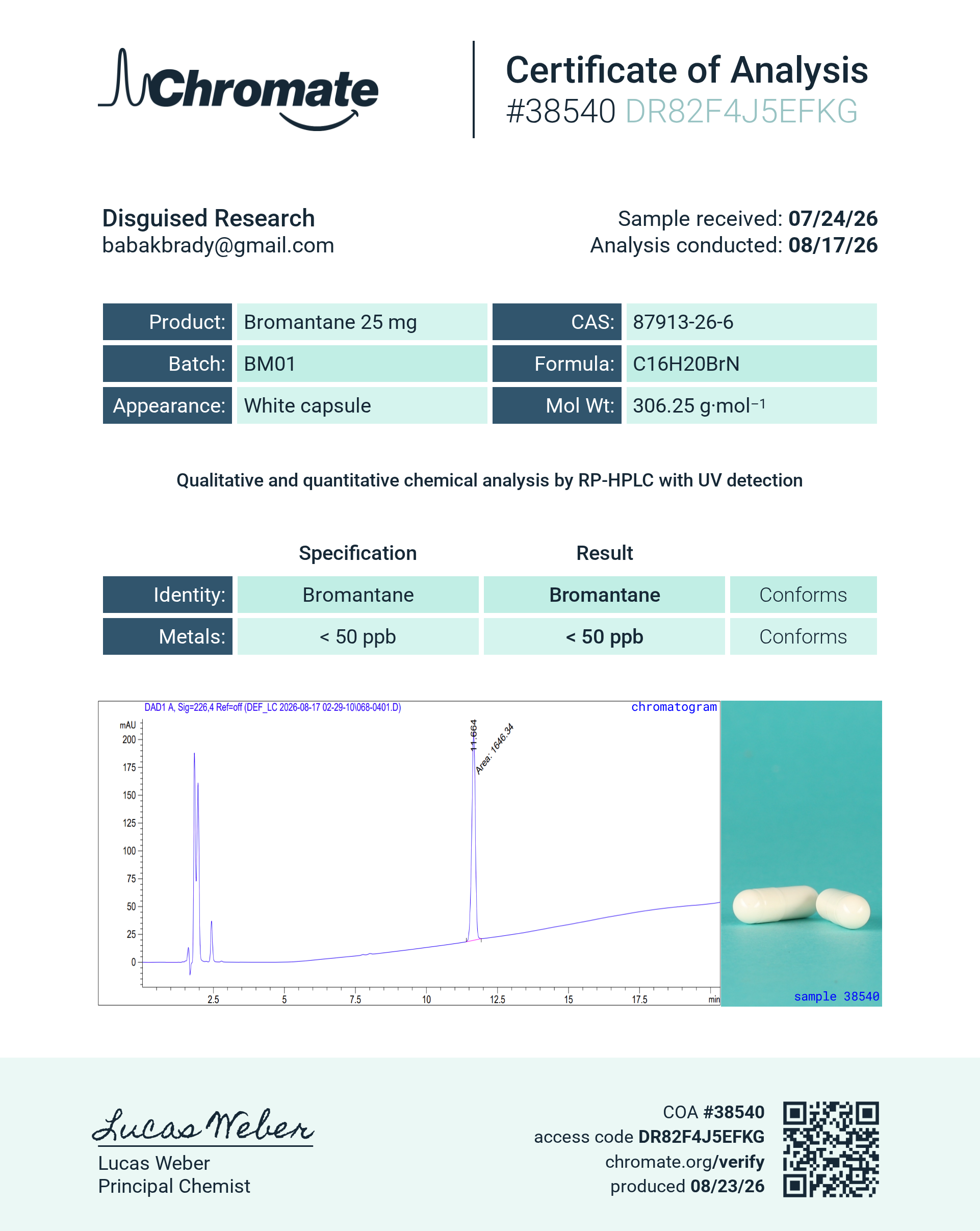
The displayed Chromate certificate reports identity and a metals result. It does not display a numerical purity or capsule-content result; neither should be inferred from the chromatogram or the product’s labeled 25 mg amount.
DA Bromantane specification record · Browse additional batches in the COA portal.
A COA concerns the sample tested and the methods reported. It is not a clinical trial, regulatory approval or proof of safety for human use. Current availability and shipping lots can change.
References
- Mikhaylova M, et al. (2007). The effects of ladasten on dopaminergic neurotransmission and hippocampal synaptic plasticity in rats. Neuropharmacology 53:601–608. DOI: 10.1016/j.neuropharm.2007.07.001.
- Viatleva OA, et al. (2000). The neuro- and psychophysiological effects of bromantane. Voen Med Zh. PMID: 10998997. Russian-language article; indexed English abstract.
- Rat-brain dopamine and serotonin study of bromantane (1995). PMID: 7580761.
References are selected primary studies and publication-status records, not a systematic review. Study findings are attributed to their authors; the COAs are supplier-associated batch documentation.
Publisher disclosure: Disguised Alpha sells research materials discussed on this page. This supplier-published reference is not independent clinical guidance. Materials are offered for laboratory research only, not human consumption. No dosing or treatment recommendation is provided.