
Dihexa is a chemically modified angiotensin IV analogue studied in experimental models of neuronal signaling and cognition. Its literature includes animal research and a retracted paper central to the proposed HGF/c-Met mechanism. That publication history is essential context when evaluating claims about synapse formation or memory.[1][3]
Identity and proposed mechanism
Dihexa was developed through modifications intended to improve the stability and biological access of angiotensin IV-related molecules. A 2013 study described experiments in rats and neuronal systems, including spatial-learning models. Such experiments generated hypotheses about synaptic biology; they did not demonstrate treatment efficacy in people.[1]
The frequently repeated HGF/c-Met explanation traces in part to a 2014 paper reporting interactions with hepatocyte growth factor and downstream signaling. Because that paper was subsequently retracted, this page treats those findings as a historical proposal rather than established mechanistic proof.[2][3]
Evidence and publication history
| Source | Context | How to read it |
|---|---|---|
| McCoy et al., 2013 [1] | Modified analogues in preclinical learning and neuronal models | Early experimental evidence; not a clinical efficacy study. |
| Benoist et al., 2014 [2] | Proposed HGF/c-Met mechanism | Retracted; retain only as part of the research history. |
| Sun et al., 2021 [4] | APP/PS1 mouse model and PI3K/AKT signaling | A separate preclinical investigation, not proof of a benefit in humans. |
| Retraction notice, 2025 [3] | Publication-status update for the 2014 paper | Must accompany any discussion relying on that paper. |
PubMed records a 2021 expression of concern followed by a 2025 retraction for the 2014 mechanism paper. Repeating its conclusions without that status would give readers an incomplete account. The retraction does not automatically adjudicate every other Dihexa study; each publication still needs its own assessment.[2][3]
What remains unproven
The studies cited here do not establish that Dihexa treats Alzheimer’s disease, improves cognition in healthy people, or has a defined long-term safety profile in humans. A mouse model captures selected features of a disease, and an experimental learning task is not the same endpoint as clinical function.
A credible interpretation should separate three questions: whether the material has the stated chemical identity, whether a pathway response can be reproduced, and whether a meaningful clinical benefit has been demonstrated. A certificate can inform the first question within its analytical scope; it cannot answer the other two. Comparisons claiming enormous superiority to another neurotrophic molecule are especially difficult to interpret without matching assays and independently supported data.
Disguised Alpha COAs and batch documentation
- Dihexa 5 mg capsules — lot 060526, ILS Laboratories · analysis dated September 23, 2026. Open certificate image.
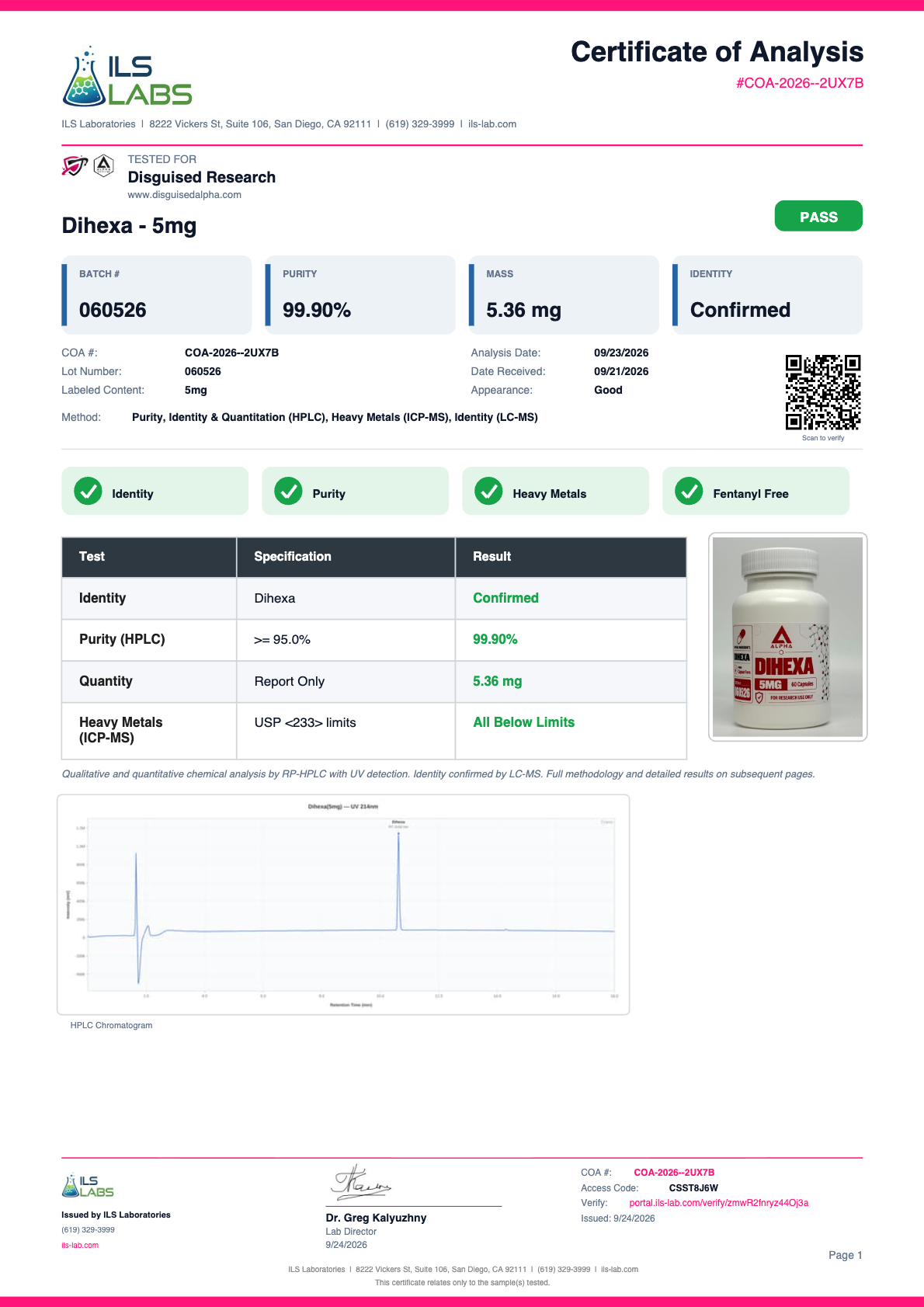
The displayed ILS summary reports 99.90% HPLC purity, 5.36 mg quantity and confirmed identity for the submitted sample. Those are different measurements and are not evidence of cognitive efficacy or clinical safety.
DA Dihexa specification record · Additional reports and formulations. A capsule report should not be used to verify an aerosol or a blend.
A COA concerns the sample tested and the methods reported. It is not a clinical trial, regulatory approval or proof of safety for human use. Current availability and shipping lots can change.
References
- McCoy AT, et al. (2013). Evaluation of metabolically stabilized angiotensin IV analogs as procognitive/antidementia agents. J Pharmacol Exp Ther 344:141–154. PMID: 23055539.
- Benoist CC, et al. (2014). HGF/c-Met mechanism study of angiotensin IV-derived peptides. J Pharmacol Exp Ther 351:390–402. RETRACTED. DOI: 10.1124/jpet.114.218735.
- Retraction notice (2025) for the Benoist et al. 2014 mechanism paper. J Pharmacol Exp Ther 392:103567. DOI: 10.1016/j.jpet.2025.103567.
- Sun X, et al. (2021). Dihexa, cognition and PI3K/AKT signaling in APP/PS1 mice. Brain Sciences 11:1487. DOI: 10.3390/brainsci11111487.
References are selected primary studies and publication-status records, not a systematic review. Study findings are attributed to their authors; the COAs are supplier-associated batch documentation.
Publisher disclosure: Disguised Alpha sells research materials discussed on this page. This supplier-published reference is not independent clinical guidance. Materials are offered for laboratory research only, not human consumption. No dosing or treatment recommendation is provided.